Complete Guide to BGS Card Grading: Prices, Standards, and Process in 2026
Beckett Grading Services (BGS) stands as one of the most prestigious and trusted names in professional card authentication and grading, earning its reputation through decades of consistent standards and meticulous evaluation processes. When collectors and investors seek to maximize their card values and ensure authenticity, BGS grading has become the gold standard for premium trading cards across sports, Pokémon, and other collectible categories. Unlike other grading companies, BGS offers detailed subgrades for centering, corners, edges, and surface quality, providing collectors with comprehensive insights into their cards’ condition and helping justify premium market prices.
Understanding BGS grading services becomes crucial for serious collectors navigating today’s competitive market, where a single grade point can mean thousands of dollars in value difference. This comprehensive guide covers everything you need to know about BGS card grading in 2026, from current BGS grading cost structures and pricing tiers to detailed submission processes and professional tips for achieving maximum grades. Whether you’re submitting your first card or managing a substantial collection, you’ll discover the latest BGS grading prices, learn proven strategies for successful submissions, and understand how BGS authentication features protect your investment while enhancing long-term market potential.
What is BGS Card Grading and Why Choose Beckett?
BGS grading represents one of the most respected authentication and grading services in the trading card industry. Beckett Grading Services has established itself as a premium choice for collectors seeking detailed evaluation of their most valuable cards, offering a comprehensive subgrade system that provides unprecedented insight into card condition.
History and Reputation of Beckett Grading Services
Founded in 1999 by Dr. James Beckett, BGS emerged from the already established Beckett Media empire that had been publishing price guides since 1984. The company revolutionized card grading by introducing the innovative subgrade system, breaking down overall condition into four distinct categories: Centering, Corners, Edges, and Surface. This detailed approach quickly gained traction among serious collectors who valued the granular feedback.
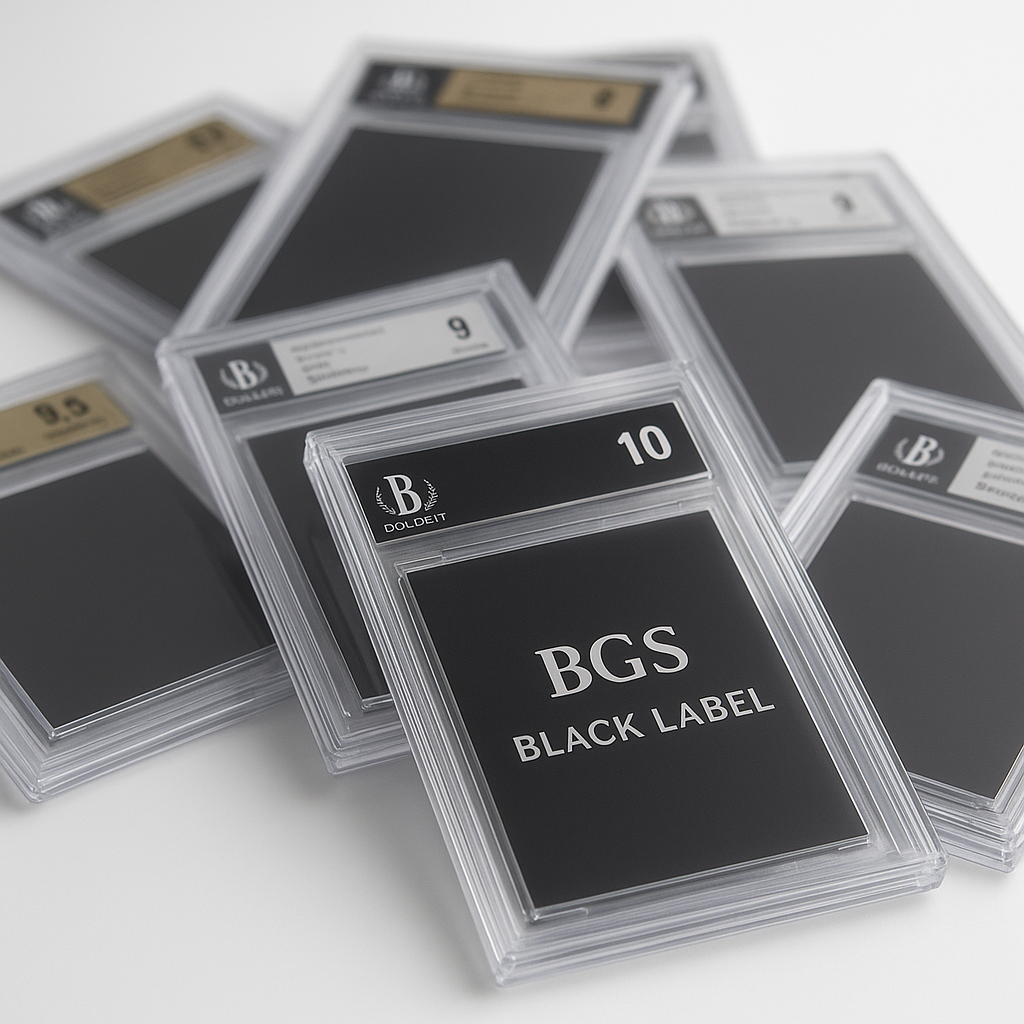
Over two decades, BGS grading has built an unparalleled reputation for consistency and accuracy. The company’s rigorous standards and detailed documentation have made BGS slabs highly sought after in the marketplace. Their population reports and registry system provide collectors with valuable market data, while the distinctive black label design has become synonymous with premium graded cards.
BGS vs Other Grading Companies (PSA, CGC, CSG)
When comparing bgs grading services to competitors, several key differentiators emerge. PSA dominates market share with faster turnaround times and lower costs, but BGS offers superior detail through subgrades. While PSA uses a simple 1-10 scale, BGS provides four individual subgrade scores that can reveal exactly why a card received its overall grade.
Market values for BGS 9.5 and BGS 10 cards often command premiums over equivalent PSA grades, particularly for modern cards where condition is paramount. The BGS Black Label (perfect 10 across all subgrades) represents the holy grail of grading, often selling for 2-3x more than regular BGS 10s. CGC and CSG have emerged as newer alternatives with competitive bgs grading cost structures, but neither has achieved BGS’s market recognition for high-end cards.
| Grading Company | Subgrades | Market Premium | Typical Turnaround |
|---|---|---|---|
| BGS | Yes (4 categories) | High for 9.5+ | 30-90 days |
| PSA | No | Standard reference | 20-45 days |
| CGC | Yes (3 categories) | Moderate | 15-30 days |
Types of BGS Grading Services (BGS, BCCG, BVG)
Beckett operates three distinct grading divisions, each serving different market segments and price points. Understanding these options helps collectors choose the most appropriate service for their needs and budget.
BGS (Beckett Grading Services) represents the flagship premium service, featuring the signature subgrade system and black label holders. BGS grading prices typically range from $20-300+ depending on declared value and service level. This tier handles cards valued up to $50,000+ and provides the most detailed analysis available in the industry.
BCCG (Beckett Collectors Club Grading) offers an economy option for lower-value cards, using a simplified 1-10 scale without subgrades. BCCG services cost significantly less than full BGS grading but provide basic authentication and condition assessment in distinctive blue holders.
BVG (Beckett Vintage Grading) specializes in pre-1981 cards, acknowledging the different condition standards appropriate for older cardboard. BVG uses modified grading criteria that account for the manufacturing limitations and aging characteristics of vintage cards, making it the preferred choice for serious vintage collectors.
For collectors looking to verify card authenticity and current market values before submitting for grading, TCG Radar provides instant card identification and real-time pricing data, helping determine whether bgs card grading makes financial sense for specific cards.
BGS Grading Standards and Scale Explained
Understanding BGS grading standards is crucial for collectors looking to maximize their card values and make informed decisions about which cards to submit. Beckett’s comprehensive grading system evaluates cards across multiple dimensions, providing detailed feedback that helps collectors understand exactly what affects their card’s final grade and market value.
The BGS 10-Point Grading Scale
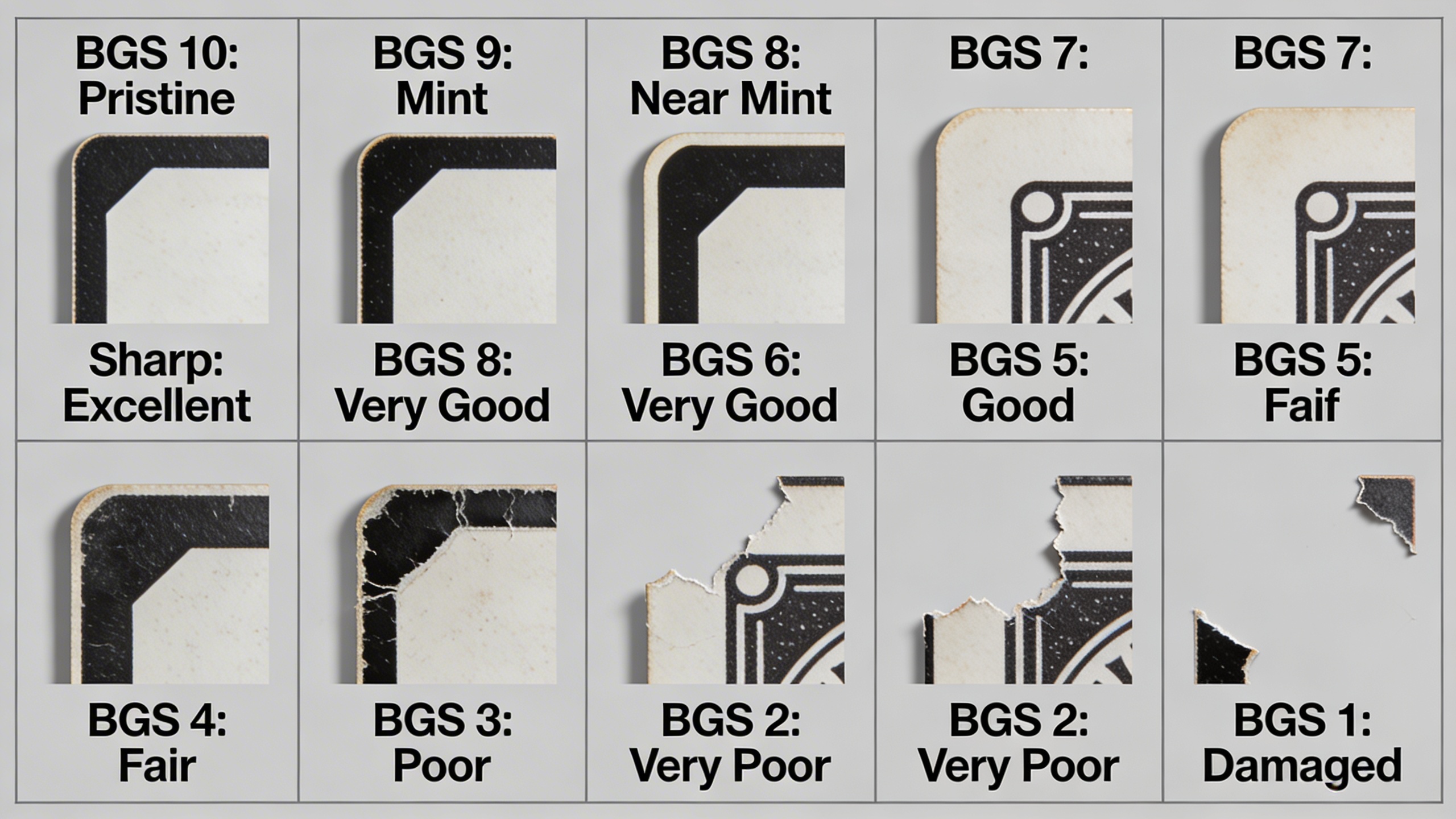
The BGS grading scale ranges from 1 to 10, with half-point increments available for most grades. Each grade level represents specific condition standards that directly impact bgs grading prices in the secondary market.
| Grade | Condition | Market Impact | Key Characteristics |
|---|---|---|---|
| BGS 10 (Pristine) | Perfect | Premium pricing | Flawless in all areas, museum quality |
| BGS 9.5 (Gem Mint) | Near Perfect | Strong market value | Minor imperfections under magnification |
| BGS 9 (Mint) | Excellent | Solid collector value | Very light wear, excellent eye appeal |
| BGS 8.5 (Near Mint+) | Very Good | Moderate premium | Light wear visible, good centering |
| BGS 8 (Near Mint) | Good | Entry-level premium | Minor wear, slight centering issues |
| BGS 7.5-6 (Excellent to Good) | Played | Below raw card value | Visible wear, centering problems |
Cards receiving BGS 9.5 or higher typically command significant premiums over raw card prices, making bgs card grading a worthwhile investment for high-value cards. The jump from BGS 9 to 9.5 can often double a card’s value, while achieving a BGS 10 can result in 3-5x price multipliers for popular cards.
Understanding BGS Subgrades (Centering, Corners, Edges, Surface)
BGS grading services provide four distinct subgrades that collectively determine the overall grade. Each subgrade receives a score from 1-10, and understanding these components helps collectors predict grades before submission.
Centering measures how evenly the card image sits within the borders. Perfect centering requires the image to be within 55/45 tolerance on all sides for a 10, while 60/40 typically receives a 9. Poor centering is often the most visible flaw and significantly impacts eye appeal.
Corners evaluation focuses on sharpness and wear. A perfect 10 requires four razor-sharp corners with no visible wear under 10x magnification. Even minor rounding or whitening drops the grade to 9 or lower. Corners are particularly vulnerable during pack opening and handling.
Edges assessment examines the card’s perimeter for nicks, roughness, or damage. Clean, smooth edges without any imperfections earn a 10, while any visible damage reduces the grade. Edge damage often occurs during cutting at the printing facility or rough handling.
Surface inspection covers print quality, scratches, indentations, and overall card face condition. Perfect surface requires flawless printing with no scratches, spots, or imperfections visible under magnification. Surface damage is often the most subjective subgrade category.
The overall grade typically equals the lowest subgrade, though BGS occasionally awards half-point bonuses when three subgrades significantly exceed the fourth. This makes identifying weak areas crucial when considering bgs grading cost versus potential returns.
BGS Black Label and Pristine Grades
The BGS Black Label 10 represents the pinnacle of card grading, requiring perfect 10 subgrades across all four categories. These labels are exceptionally rare, with pull rates estimated at less than 1% of all BGS 10 submissions. Black Label cards command massive premiums, often selling for 5-10x more than regular BGS 10 cards.
Requirements for Black Label status include:
- Perfect 10 centering (within 55/45 tolerance)
- Four absolutely pristine corners with zero wear
- Completely smooth, undamaged edges
- Flawless surface with perfect print quality
BGS Pristine 10 (gold label) cards receive a 10 overall grade but have at least one subgrade below 10. These still command significant premiums over BGS 9.5 cards but lack the extreme rarity value of Black Labels.
For collectors tracking card values and considering grading submissions, using tools like TCG Radar helps identify cards with BGS grading potential by checking current market prices and recent sales data. This information proves invaluable when calculating whether bgs grading prices justify the submission cost for specific cards.
Understanding these grading standards helps collectors make informed decisions about which cards warrant professional grading and sets realistic expectations for grades based on visible condition factors.
BGS Grading Costs and Pricing Structure 2026
Understanding BGS grading costs is essential before submitting your cards, as pricing varies significantly based on service level, declared value, and turnaround time preferences. Beckett’s pricing structure has evolved to accommodate different collector needs while maintaining their premium grading standards.
Current BGS Grading Prices by Service Level
BGS grading services are structured into three primary tiers, each offering different turnaround times and pricing based on your card’s declared value. The economy service represents the most cost-effective option for standard submissions.
| Service Level | Declared Value | Price Per Card | Turnaround Time |
|---|---|---|---|
| Economy | Up to $499 | $22 | 45-60 business days |
| Standard | Up to $499 | $35 | 20-25 business days |
| Express | Up to $499 | $65 | 10-12 business days |
| Premium | $500-$2,499 | $125 | 10-12 business days |
| Super Premium | $2,500+ | 3% of declared value | 5-7 business days |
For collectors managing large submissions, the economy tier offers the best value for modern cards and lower-value vintage pieces. Express services become worthwhile when you need cards back quickly for sales or trade deadlines.
Additional Fees and Turnaround Times
Beyond base BGS grading prices, several additional costs can impact your total investment. Subgrades, which provide detailed scoring for centering, corners, edges, and surface, add $10 per card but significantly increase market appeal for high-grade specimens.
Special services include autograph authentication ($15), which pairs well with BGS card grading for signed memorabilia. Oversized cards incur a $5 surcharge, while cards requiring special holders face additional fees. International submissions from outside North America include return shipping costs that can range from $25-75 depending on destination and insurance requirements.
Rush services occasionally become available during peak seasons, typically adding 50-100% to standard pricing. These emergency options prove valuable for time-sensitive submissions before major shows or auction deadlines.
Value vs Cost Analysis for Different Card Types
Determining when BGS grading justifies the investment requires careful consideration of potential value increase versus grading costs. Modern rookie cards from current sets rarely benefit from economy grading unless they’re already showing mint characteristics, as the $22 fee often exceeds the card’s raw value.
Vintage cards from the 1950s-1980s represent the sweet spot for bgs grading services, particularly those valued between $100-500 in raw condition. A 1986 Fleer Michael Jordan in BGS 9 condition commands $800-1,200, while the same card ungraded sells for $200-400, easily justifying the grading investment.
High-value modern cards like Patrick Mahomes rookie cards or rare parallels benefit most from express or premium services, as the faster turnaround preserves market timing opportunities. When dealing with cards valued over $1,000, the percentage-based super premium service often provides better value than flat-rate alternatives.
For accurate pre-submission valuation, consider using TCG Radar to scan and check current market prices, helping you choose the most cost-effective BGS grading tier for your specific cards.
Step-by-Step BGS Submission Process
Successfully submitting cards for BGS grading requires careful preparation and attention to detail. Following the proper procedures ensures your cards arrive safely and receive accurate evaluation. This comprehensive process breakdown covers everything from initial card selection to receiving your graded results.
Preparing Your Cards for BGS Submission
Proper card preparation significantly impacts your BGS grading results and protects your investment. Start by selecting cards in excellent condition, as even minor flaws can substantially affect final grades and diminish the value relative to bgs grading cost.
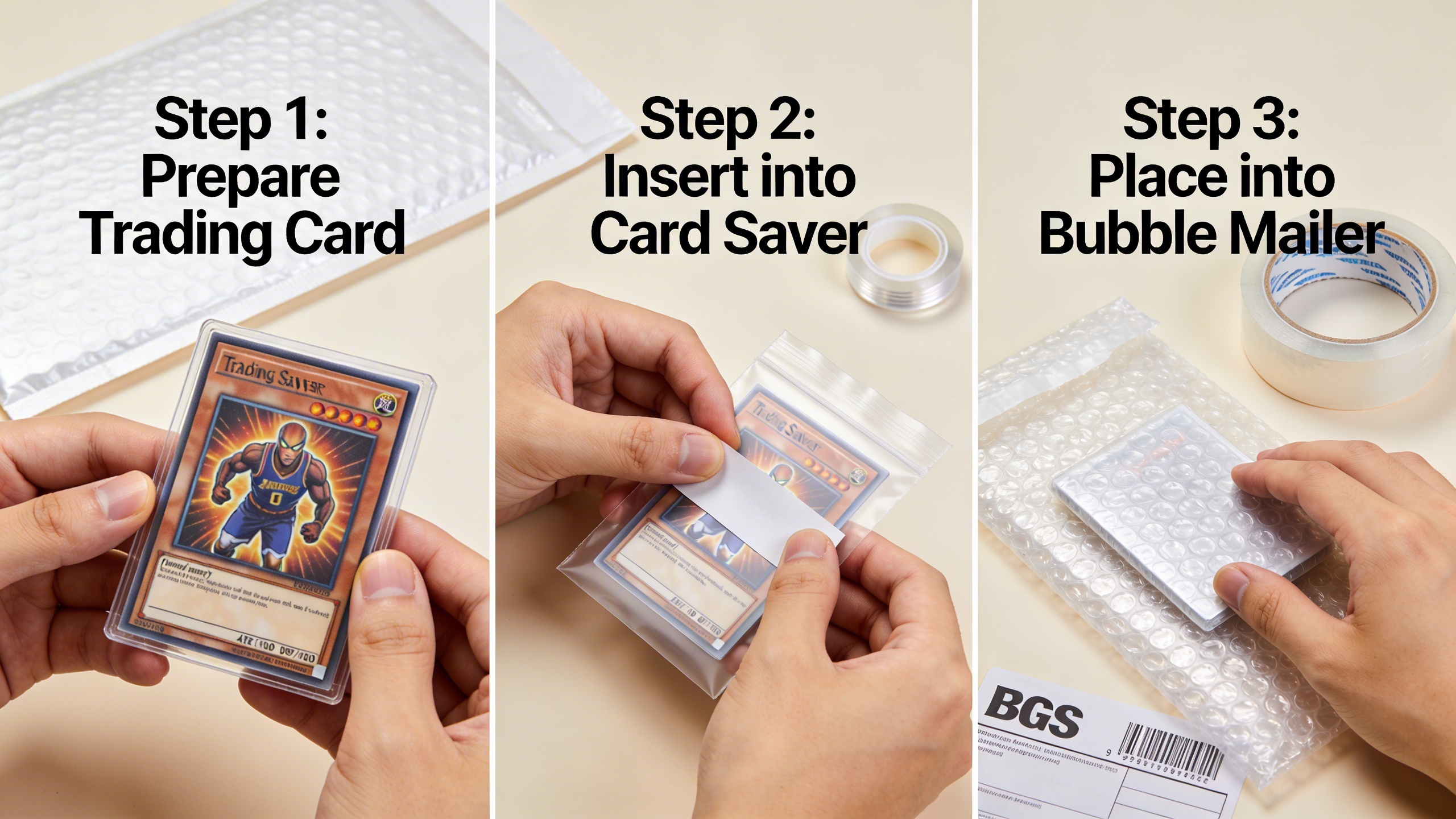
Clean your cards gently using a microfiber cloth to remove surface dust and fingerprints. Avoid using any liquids or cleaning solutions, as these can damage card surfaces and result in lower grades. Examine each card under bright lighting to identify potential defects like scratches, dents, or centering issues that might affect the final grade.
Place each card immediately into a penny sleeve, ensuring the opening faces away from the card’s top edge to prevent dust accumulation. Follow this with a toploader or card saver for additional protection. Never remove cards from protective sleeves once they’re prepared for submission, as handling increases the risk of damage.
Before finalizing your submission, use TCG Radar to verify current market values for your selected cards. This helps ensure the potential grade increase justifies the bgs grading prices and submission costs.
Online Submission and Shipping Requirements
BGS requires online submission forms for all grading services. Create an account on the Beckett website and select your desired service level based on turnaround time preferences and budget considerations. Economy service typically costs $20-25 per card with 45-60 business day processing, while Express service ranges from $50-75 per card with 10-15 business day turnaround.
Complete the submission form accurately, including:
- Card name, set, and card number
- Estimated value for insurance purposes
- Service level selection
- Special requests (autograph authentication, etc.)
Print your completed submission form and include it with your cards. Organize cards in the exact order listed on your form to streamline BGS processing and reduce handling time.
Package cards securely using bubble wrap or foam padding inside a sturdy cardboard box. Include your printed submission form in a plastic sleeve to protect against moisture. Ship via FedEx, UPS, or USPS with tracking and insurance coverage matching your declared card values. BGS recommends insuring packages for the full declared value to protect against loss or damage during transit.
Tracking Your Submission and Receiving Results
Monitor your submission status through the BGS customer portal using your submission number. The system updates automatically as cards progress through receiving, grading, and encapsulation stages. Typical processing times vary by service level, with current turnaround times ranging from 10 business days for premium services to 60+ business days for economy submissions.
BGS sends email notifications when submissions reach key milestones: received, entered into system, grading complete, and shipped back to customer. These updates help manage expectations and provide peace of mind during the waiting period.
Upon completion, BGS ships graded cards back using the same shipping method you selected for submission. Inspect your returned cards immediately upon arrival and contact BGS customer service within 48 hours if you notice any discrepancies or damage.
Your graded cards arrive in protective BGS holders with detailed grade breakdowns for centering, corners, edges, and surface condition. These individual sub-grades provide valuable feedback about card quality and help justify the overall grade assigned.
For valuable cards receiving high grades (BGS 9.5 or 10), consider additional insurance when storing or selling these items. The premium associated with bgs card grading often results in significant value increases for cards achieving top grades, making proper post-grading care essential for protecting your investment.
Keep detailed records of your bgs grading services costs and results for tax purposes if you’re selling cards as business income. This documentation helps track profitability and informs future submission decisions based on actual return on investment data.
BGS Grading Tips for Maximum Value
Maximizing your return on investment with bgs grading requires strategic decision-making and careful preparation. The key to profitable submissions lies in understanding which cards justify the bgs grading cost and how to present them for optimal results.
Selecting Cards Worth Grading
ROI calculations should drive every grading decision. Before submitting to bgs grading services, research the price differential between ungraded and graded versions of your card. A 2022 Topps Chrome Julio Rodríguez rookie card might sell for $50 raw but $300+ in BGS 9.5 condition. With bgs grading prices ranging from $20-75 depending on service level, this represents a clear profit opportunity.
Focus on cards with significant grade premiums: vintage cards (pre-1980), modern rookie cards of star players, low-pop parallels, and autographed cards. Avoid grading base cards from overprinted sets unless they’re true condition rarities. Use TCG Radar to quickly check current market values and identify cards with strong grading upside potential.
Pre-Grading Card Assessment
Develop systematic visual inspection techniques to predict grades accurately. Examine cards under bright, natural lighting with a magnifying glass. Check centering by measuring borders – BGS requires near-perfect centering for 9+ grades. Look for print defects, surface scratches, and corner wear that might not be immediately visible.
Create a simple scoring system: rate centering, corners, edges, and surface condition on the 1-10 BGS scale. Cards scoring 8.5+ across all categories are prime bgs card grading candidates. Document any flaws with high-resolution photos – this helps you track improvement in assessment skills and avoid costly mistakes.
Market research timing is crucial for submission decisions. Monitor population reports on BGS website to understand scarcity. A card with only 12 BGS 10s versus 200+ PSA 10s might command premium pricing. Track recent sales data for 30-60 days before submitting to ensure current demand supports the investment.
Common Mistakes to Avoid
The biggest error collectors make is submitting cards without proper market analysis. Don’t grade cards simply because they “look mint” – verify that graded versions sell for significantly more than raw copies plus grading fees. Factor in the 4-6 week turnaround time and potential grade disappointment.
Avoid rushing submissions during market peaks. Timing matters significantly – submitting a rookie card during their breakout season often yields better ROI than waiting until hype dies down. However, don’t chase every trending player without fundamental research.
Storage and shipping mistakes can destroy value before cards reach BGS. Use penny sleeves, toploaders, and team bags for protection. Never remove cards from holders immediately before shipping – oils from fingers can cause surface issues. Include adequate padding and use tracking for all submissions.
Finally, resist the urge to crack and resubmit cards that grade lower than expected. BGS maintains detailed records, and repeated submissions of the same card can result in service restrictions. Focus on improving your pre-grading assessment skills instead of gambling on grade bumps.
BGS Authentication and Security Features
Beckett Grading Services has implemented multiple layers of security to protect collectors from counterfeit slabs and ensure the integrity of their bgs grading services. Understanding these authentication features is crucial when purchasing graded cards on the secondary market or verifying your own submissions.
BGS Label Security Features
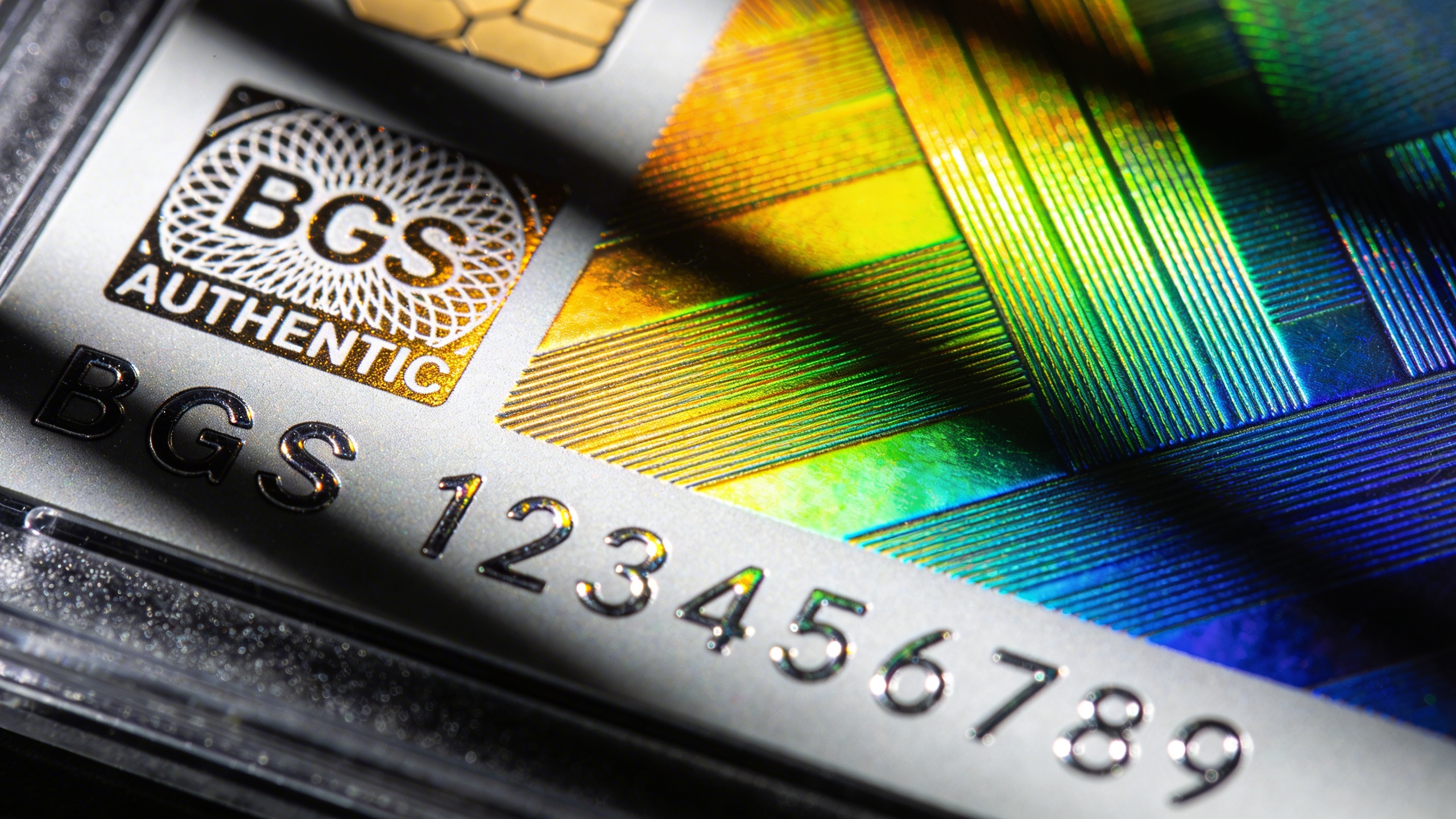
Modern BGS slabs incorporate several sophisticated security elements that make counterfeiting extremely difficult. The most prominent feature is the holographic BGS logo on the label, which displays a rainbow effect when tilted under light. This hologram contains micro-printing that’s nearly impossible to replicate accurately.
The certification number follows a specific format and connects directly to BGS’s verification database. Additionally, the label paper itself has a unique texture and weight that differs from standard printing materials. The font used for grade numbers and card information follows precise specifications, with consistent spacing and character formation that counterfeiters struggle to match perfectly.
BGS also uses tamper-evident sealing on their slabs. Any attempt to open or reseal a genuine BGS holder will leave visible evidence of tampering along the edges where the two halves meet.
How to Verify Authentic BGS Slabs
The most reliable method to verify a BGS slab is through their online certification lookup system. Simply enter the certification number from the label into BGS’s database at beckett.com. This will display the exact card details, grade, and submission date, allowing you to cross-reference with the physical slab.
When examining a slab physically, check the hologram’s clarity and movement. Authentic holograms show crisp, defined rainbow patterns. The label should sit flush against the holder without bubbles or lifting edges. The BGS logo should appear sharp and properly aligned, not pixelated or blurry.
Compare the card details on the label with the actual card inside. Genuine BGS labels accurately describe the card’s set, year, and player name without spelling errors or formatting inconsistencies.
Protection Against Counterfeits
Several red flags indicate potential counterfeit slabs. Poor print quality on labels, missing or weak holographic effects, and certification numbers that don’t verify in the BGS database are immediate warning signs. Be particularly cautious with high-value cards like Michael Jordan rookies or vintage Mickey Mantle cards, as these are frequently targeted by counterfeiters.
When purchasing expensive graded cards, always verify the certification number before completing the transaction. If selling your collection, consider using TCG Radar to quickly scan and verify current market values before listing, ensuring you price authentic BGS-graded cards appropriately.
Remember that legitimate bgs grading cost and bgs grading prices reflect the security measures and authentication systems BGS provides. Extremely cheap graded cards from unknown sources should raise immediate suspicion about authenticity.
BGS Graded Card Market and Investment Potential
The market for BGS graded cards has demonstrated remarkable resilience and growth over the past several years, establishing Beckett as a premier choice for serious collectors and investors. Understanding market dynamics is crucial when considering bgs grading cost as an investment in your collection’s future value.
BGS vs PSA Market Performance
BGS graded cards consistently command premium prices in the marketplace, particularly for high-grade specimens. BGS Black Label 10 cards routinely sell for 2-3x more than their PSA 10 counterparts, with some iconic cards reaching even higher multiples. For example, a 2003 LeBron James Topps Chrome BGS Black Label recently sold for $312,000, while comparable PSA 10 examples trade in the $180,000-220,000 range.
The subgrade system gives BGS a distinct advantage in the premium market segment. Cards receiving four perfect 10 subgrades create artificial scarcity that drives collector demand. This premium positioning makes bgs grading services particularly attractive for high-value vintage and modern cards where condition is paramount.
| Grade | BGS Premium vs PSA | Market Preference |
|---|---|---|
| Perfect Grade (BGS 10 Black Label vs PSA 10) | 150-300% premium | BGS strongly preferred |
| Near Perfect (BGS 9.5 vs PSA 10) | Even to slight BGS premium | Split preference |
| Lower Grades (BGS 9 vs PSA 9) | PSA slight premium | PSA preferred |
Popular Card Categories for BGS Grading
Certain card categories show particularly strong performance when submitted for bgs card grading. Modern basketball cards, especially rookie cards from 2003-2020, represent the most active BGS market segment. Pokémon cards have emerged as another dominant category, with BGS Black Label Base Set cards commanding extraordinary premiums.
Vintage cards from 1980-1999 perform exceptionally well in BGS holders, as the subgrade system helps buyers understand exactly where condition issues exist. Football and baseball rookies from this era regularly achieve 20-40% premiums over raw examples when graded BGS 9 or higher.
For collectors managing extensive collections, using TCG Radar helps identify which cards justify the bgs grading prices through accurate market value assessments and condition evaluation.
Future Outlook for BGS Graded Cards
The BGS graded card market shows strong fundamentals heading into 2026. Institutional investment continues flowing into trading cards, with BGS Black Labels viewed as the ultimate trophy assets. The company’s authentication technology and tamper-evident holders provide security that institutional buyers demand.
Emerging markets in Asia and Europe are driving increased demand for BGS graded cards, particularly in Pokémon and basketball categories. This global expansion suggests continued growth potential for BGS grading services.
However, investors should consider that bgs grading cost represents just the entry point. Long-term value depends on card selection, timing, and market conditions. Focus on established players, key rookie cards, and cards with strong fundamentals rather than chasing short-term trends.
The outlook remains positive for BGS as their reputation for strict grading standards and premium market positioning continues attracting serious collectors willing to pay for quality and authenticity.
Frequently Asked Questions
How much does BGS grading cost in 2026?
BGS grading costs range from $20 for Economy service (45-day turnaround, $499 max value) to $300+ for Express service (5-day turnaround, $10,000+ value). Mid-tier options include Standard ($50, 20-day turnaround) and Premium ($150, 10-day turnaround). Prices vary based on declared card value and desired turnaround time.
What is the difference between BGS, BCCG, and BVG grading?
BGS is Beckett's premium service offering detailed subgrades and pristine 10 ratings, ideal for high-value modern cards. BCCG provides basic numerical grades (1-10) for lower-value cards at budget pricing. BVG (Beckett Vintage Grading) specializes in pre-1981 cards with vintage-specific standards and authentication expertise.
How long does BGS grading take?
BGS turnaround times range from 5 business days for Express service to 45 business days for Economy submissions. Standard service typically takes 20 business days, while Premium averages 10 business days. Processing times may extend during peak seasons or high submission volumes.
Is BGS grading better than PSA for sports cards?
BGS excels for modern cards seeking perfect 10 grades due to detailed subgrades and the coveted Black Label 10, often commanding premium prices. PSA generally holds stronger market presence for vintage cards and maintains higher population reports. The choice depends on card era, condition expectations, and target collector market.
What cards should I send to BGS for grading?
Send high-grade modern cards (2000+) with potential for 9+ grades, especially rookie cards, autographs, and low-numbered parallels worth $100+. Focus on cards with sharp corners, perfect centering, and pristine surfaces that could achieve BGS 9.5 or 10 grades. Avoid lower-value cards unless using BCCG service for authentication purposes.