Rare Coins: The Complete Collector’s Guide to Valuable and Collectible Coins in 2026
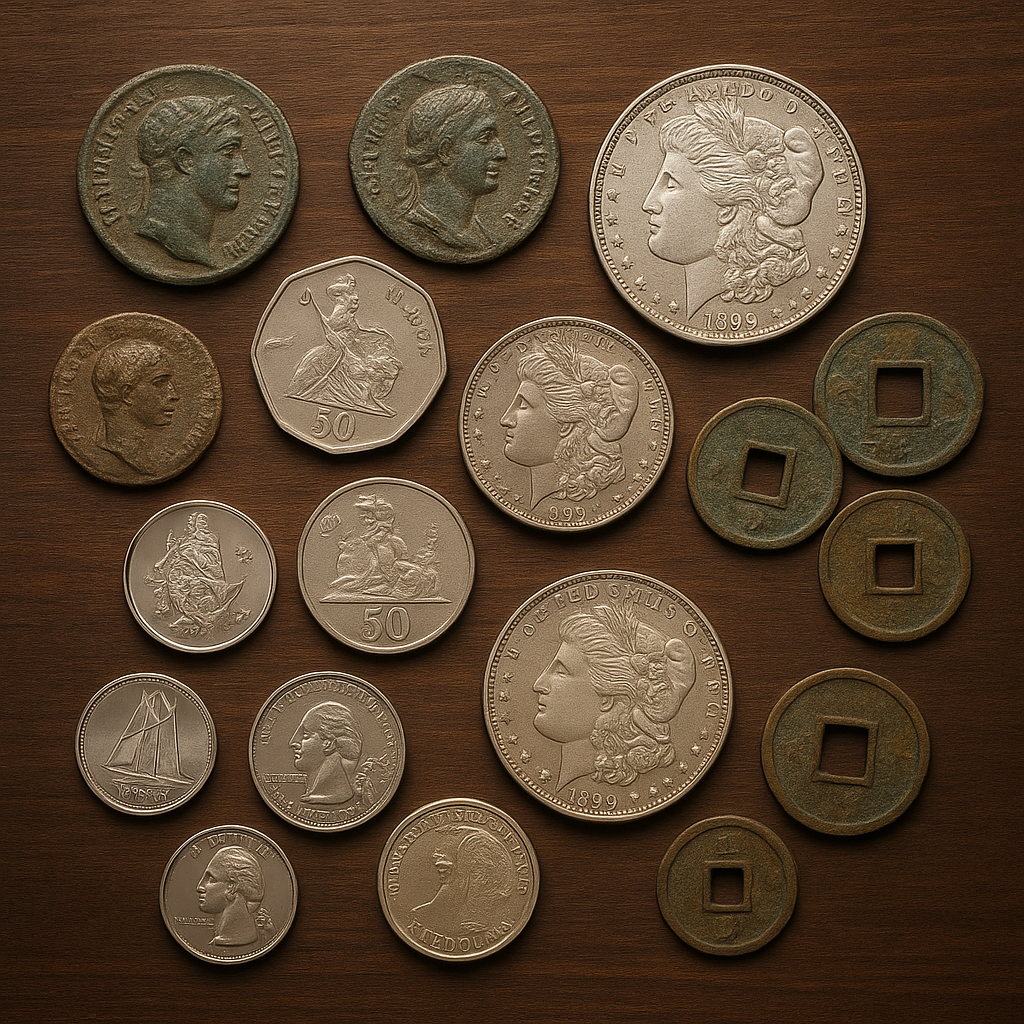
The world of coin collecting offers an extraordinary blend of historical discovery and financial opportunity, where everyday pocket change can hide remarkable treasures worth hundreds or even thousands of times their face value. From rare coins that survived ancient civilizations to modern commemorative coin releases that capture pivotal moments in history, numismatics presents collectors with tangible connections to the past while building portfolios that often appreciate significantly over time. Whether you’re examining British 50p coins for scarce designs, hunting for valuable mint coins from prestigious minting facilities, or exploring ancient coins that once circulated in Roman marketplaces, each piece tells a unique story while potentially delivering substantial returns.
This comprehensive guide equips both newcomers and seasoned collectors with the essential knowledge needed to navigate today’s dynamic coin market successfully. You’ll discover how to identify valuable specimens hiding in circulation, understand the factors that drive collectible value, and learn proven strategies for building a diversified collection that balances historical significance with investment potential. From decoding mintage numbers and condition grades to recognizing authentication markers and market trends, we’ll cover every aspect of smart coin collecting in 2026’s evolving landscape.
Understanding Coin Collecting Fundamentals
Coin collecting represents one of humanity’s oldest hobbies, combining historical preservation with investment potential. Whether you’re drawn to ancient coins from Roman times or modern commemorative coin releases, understanding the fundamental principles of numismatics will guide your collecting journey and help you make informed decisions about valuable acquisitions.
What Makes a Coin Valuable and Collectible
The value of rare coins depends on four primary factors: rarity, condition, demand, and historical significance. Mintage numbers serve as the foundation for determining rarity—coins produced in smaller quantities typically command higher premiums. For example, the 2009 Kew Gardens 50p coins had a mintage of only 210,000, making them worth significantly more than their face value today.
Age alone doesn’t guarantee value. Many ancient coins from the Roman Empire are surprisingly affordable despite being over 1,500 years old, simply because millions were minted and have survived. Conversely, some modern mint coins can be extremely valuable due to minting errors or extremely limited production runs.
Market demand plays a crucial role in pricing. Commemorative coin series celebrating popular themes like wildlife, royalty, or historical events often attract premium prices from collectors. The interplay between collectors, investors, and general public interest creates dynamic pricing that can fluctuate based on cultural trends and economic conditions.
Coin Grading and Condition Assessment
Professional coin grading follows standardized scales that determine market value. The Sheldon Scale, ranging from 1 to 70, provides the industry standard for condition assessment. Coins graded MS-60 to MS-70 represent mint state specimens with no signs of circulation wear, while lower grades indicate varying degrees of wear and damage.
Professional grading services like PCGS (Professional Coin Grading Service) and NGC (Numismatic Guaranty Corporation) provide authentication and encapsulation services. These third-party evaluations offer crucial protection against counterfeits and provide standardized condition reports that facilitate trading and insurance valuation.
Key grading factors include luster, strike quality, surface preservation, and eye appeal. Even minor differences in condition can result in substantial value variations. A Morgan silver dollar grading MS-63 might sell for $150, while the same coin in MS-65 condition could command $800 or more.
Essential Tools for Coin Collectors
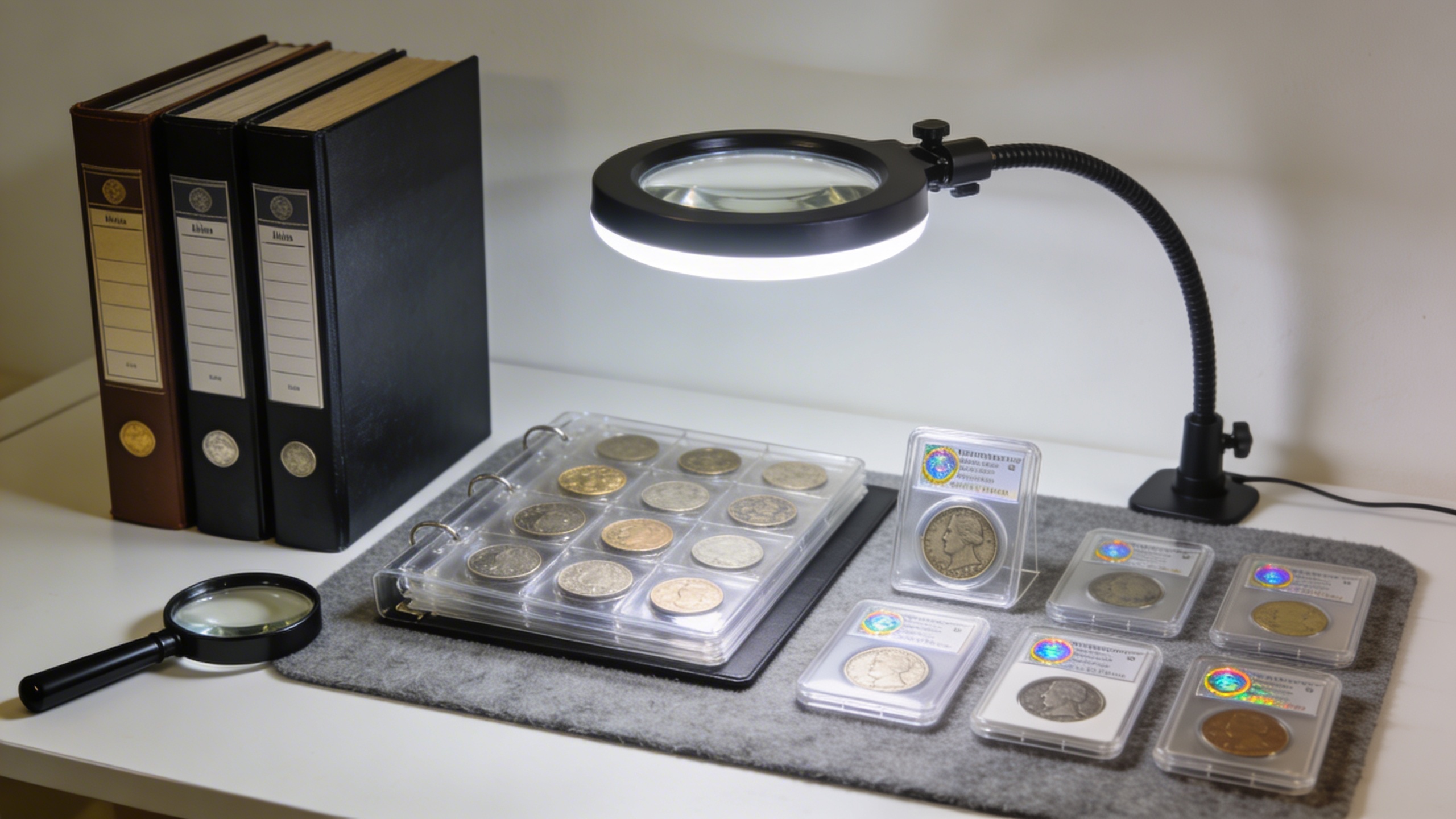
Proper equipment protects your investment and enhances your collecting experience. A quality magnifying glass or jeweler’s loupe (10x magnification minimum) allows detailed examination of surface features, mint marks, and potential varieties. LED lighting provides consistent illumination for accurate condition assessment.
Storage solutions must balance accessibility with preservation. Acid-free coin holders, albums, and storage boxes prevent environmental damage. Avoid PVC-containing materials that can cause long-term chemical reactions. For valuable specimens, consider professional-grade storage systems with climate control capabilities.
Digital tools have revolutionized modern collecting. Reference guides, price databases, and collection management software help track acquisitions and monitor market values. Many collectors now use specialized apps to catalog their holdings and research potential purchases.
Handling techniques require careful attention. Always hold coins by their edges, work over soft surfaces, and avoid cleaning unless absolutely necessary. Professional conservation services can address serious condition issues without damaging numismatic value.
Building relationships with reputable dealers, joining collector organizations, and attending coin shows provide valuable learning opportunities. The American Numismatic Association offers educational resources and networking opportunities for collectors at all experience levels.
Understanding these fundamentals creates the foundation for successful coin collecting. Whether you’re pursuing ancient coins for their historical significance or modern commemorative coin series for their artistic merit, applying these principles will help you build a collection that provides both personal satisfaction and potential financial returns.
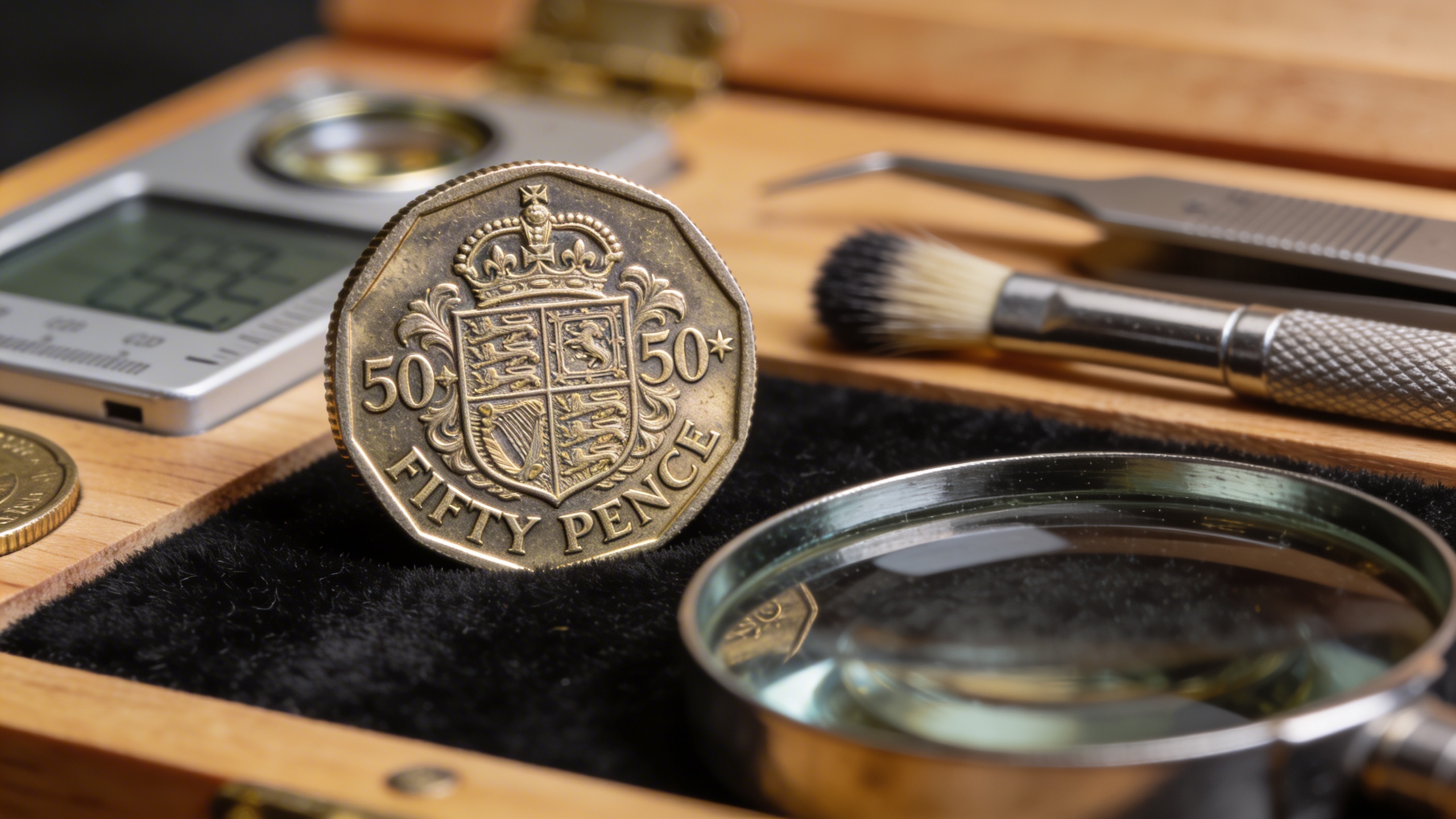
British 50p Coins: Hidden Treasures in Your Change
Among the most accessible entry points into rare coins collecting, British 50p pieces offer extraordinary opportunities for discovering valuable treasures hiding in everyday circulation. Since the introduction of the heptagonal 50p coin in 1969, the Royal Mint has produced numerous limited edition releases that now command impressive premiums among collectors worldwide.
The appeal of 50p coin collecting lies in its democratic nature—unlike ancient coins that require substantial investment, these modern collectibles can still be found in your pocket change. However, certain releases have achieved legendary status, with some specimens selling for thousands of pounds at auction.
Rarest 50p Coins Worth Thousands
The undisputed king of valuable 50p coins remains the 2009 Kew Gardens 50p, with a mintage of just 210,000 pieces. This commemorative coin, celebrating the 250th anniversary of the Royal Botanic Gardens, regularly sells for £150-£200 in circulated condition, while uncirculated examples can fetch £300-£500. The coin features the iconic Chinese Pagoda surrounded by botanical illustrations, making it instantly recognizable to collectors.
Olympic-themed releases from 2011-2012 represent another goldmine for collectors. The Football 50p, with a mintage of 1.125 million, typically trades for £15-£25, while the Wrestling design commands £20-£30. The most valuable Olympic 50p features the Triathlon design, often selling for £30-£40 due to its relative scarcity and striking visual appeal.
The 2016 Beatrix Potter series introduced character-themed designs that immediately captured public imagination. The original Peter Rabbit 50p, with 9.6 million minted, sells for £5-£8, while the rarer Jemima Puddle-Duck design commands £10-£15. These commemorative coin releases demonstrate how modern mint coins can quickly appreciate when demand exceeds supply.
Expensive 50p Commemorative Editions
Beyond individual rarities, several commemorative series have established themselves as blue-chip investments within the 50p collecting market. The 2019 Sherlock Holmes collection features four designs celebrating the detective’s 160th anniversary, with complete sets trading for £25-£35.
The Brexit 50p, officially titled “Peace, prosperity and friendship with all nations,” generated controversy and collector interest in equal measure. Despite a large mintage of 10 million pieces, early releases and error variants have achieved premiums of £5-£10 above face value.
Royal commemoratives consistently perform well in the secondary market. The 2018 representation of the People Act 50p, marking 100 years of women’s suffrage, regularly sells for £8-£12. Similarly, the 2020 VE Day 75th anniversary design maintains steady demand at £6-£10 among collectors seeking historically significant pieces.
| Coin Design | Year | Mintage | Current Value Range |
|---|---|---|---|
| Kew Gardens | 2009 | 210,000 | £150-£500 |
| Olympic Football | 2011 | 1,125,000 | £15-£25 |
| Olympic Wrestling | 2011 | 1,129,500 | £20-£30 |
| Peter Rabbit | 2016 | 9,600,000 | £5-£8 |
How to Spot Valuable 50p Coins
Successful 50p hunting requires systematic approach and keen observation skills. Start by examining the date and design—any coin featuring special artwork rather than Britannia deserves closer inspection. Check for mintage information, as releases under 5 million pieces typically carry premiums.
Condition plays a crucial role in determining value. Uncirculated examples with sharp details and minimal wear command significantly higher prices than heavily circulated specimens. Look for coins with original mint luster and absence of scratches or discoloration.
Pay special attention to error coins, which can be exceptionally valuable. Common errors include off-center strikes, doubled dies, and wrong metal compositions. The 2008 “New Pence” error, where old terminology appeared on new-style coins, can sell for £50-£100.
Unlike ancient coins that require specialized knowledge for authentication, most 50p varieties can be verified through online databases and collector guides. The Royal Mint’s official website provides comprehensive mintage figures and design specifications for all releases since 1969.
Regular bank visits and change checking remain the most cost-effective hunting methods. Many collectors report finding valuable pieces in everyday transactions, proving that significant discoveries don’t require substantial upfront investment in rare coins collecting.
American Dollar Coins and Their Collectible Value
American dollar coins represent some of the most sought-after pieces in the rare coins market, offering collectors opportunities ranging from affordable modern issues to museum-quality specimens worth thousands. Unlike the British 50p coins discussed earlier, dollar coins provide a comprehensive view of American numismatic history spanning over two centuries.
Morgan and Peace Silver Dollars
The Morgan Silver Dollar (1878-1921) and Peace Silver Dollar (1921-1935) remain the cornerstone of American coin collecting. Key dates command premium prices, with the 1893-S Morgan reaching $100,000+ in mint condition. The 1916-D Mercury Dime and 1909-S VDB Lincoln cent pale in comparison to the legendary 1893-S Morgan’s rarity.
Mint marks play a crucial role in valuation. Carson City (CC) mint marks consistently add significant premiums, with the 1885-CC Morgan valued at $500-800 in MS-63 condition compared to $45-60 for Philadelphia mint examples. The 1928 Peace Dollar, minted only in Philadelphia, represents the series’ key date at $400-500 in circulated condition.
| Coin | Year | Mint Mark | Circulated Value | Mint State Value |
|---|---|---|---|---|
| Morgan Dollar | 1893 | S | $5,000-8,000 | $100,000+ |
| Peace Dollar | 1928 | None (P) | $400-500 | $800-1,200 |
| Morgan Dollar | 1885 | CC | $350-450 | $500-800 |
Modern Presidential Dollar Series
The Presidential Dollar series (2007-2020) offers accessible entry points for new collectors while hiding valuable errors. Most circulated examples trade at face value, but mint coins in original government packaging maintain modest premiums of $2-5 per coin.
The series includes several commemorative coin releases honoring each president, creating systematic collecting opportunities. Edge lettering errors during early production runs have created valuable varieties, particularly in the Washington, Adams, and Jefferson dollars where missing edge inscriptions can increase values to $50-150.
Proof versions command higher premiums, with complete annual sets valued at $15-25. The series conclusion in 2020 with the Bush dollar has sparked renewed collector interest, particularly for low-mintage issues from the Denver mint.
Error Coins and Varieties to Watch For
Dollar coin errors represent some of the most dramatic value increases in modern numismatics. Double-die varieties, particularly in Morgan dollars, can transform common dates into five-figure rarities. The 1921 Morgan with doubled die reverse commands $1,500-3,000 compared to $30-35 for normal examples.
Presidential dollar errors include missing edge lettering, double edge lettering, and the famous “Godless” dollars missing “IN GOD WE TRUST.” These errors typically add $25-100 to common dates, though dramatic examples can reach $500+.
Off-center strikes in dollar coins create particularly striking errors due to their large size. A 10-15% off-center Presidential dollar might bring $75-150, while 50%+ off-center examples can exceed $500. Unlike ancient coins where condition issues are expected, modern dollar coin errors must show clear, dramatic deviations to command premiums.
Collectors should examine edge lettering carefully, as inverted or multiple impressions create valuable varieties often overlooked in circulation. These discoveries continue the tradition of finding valuable rare coins in everyday transactions, much like discovering valuable 50p coins in British change.
Ancient Coins: Collecting Pieces of History
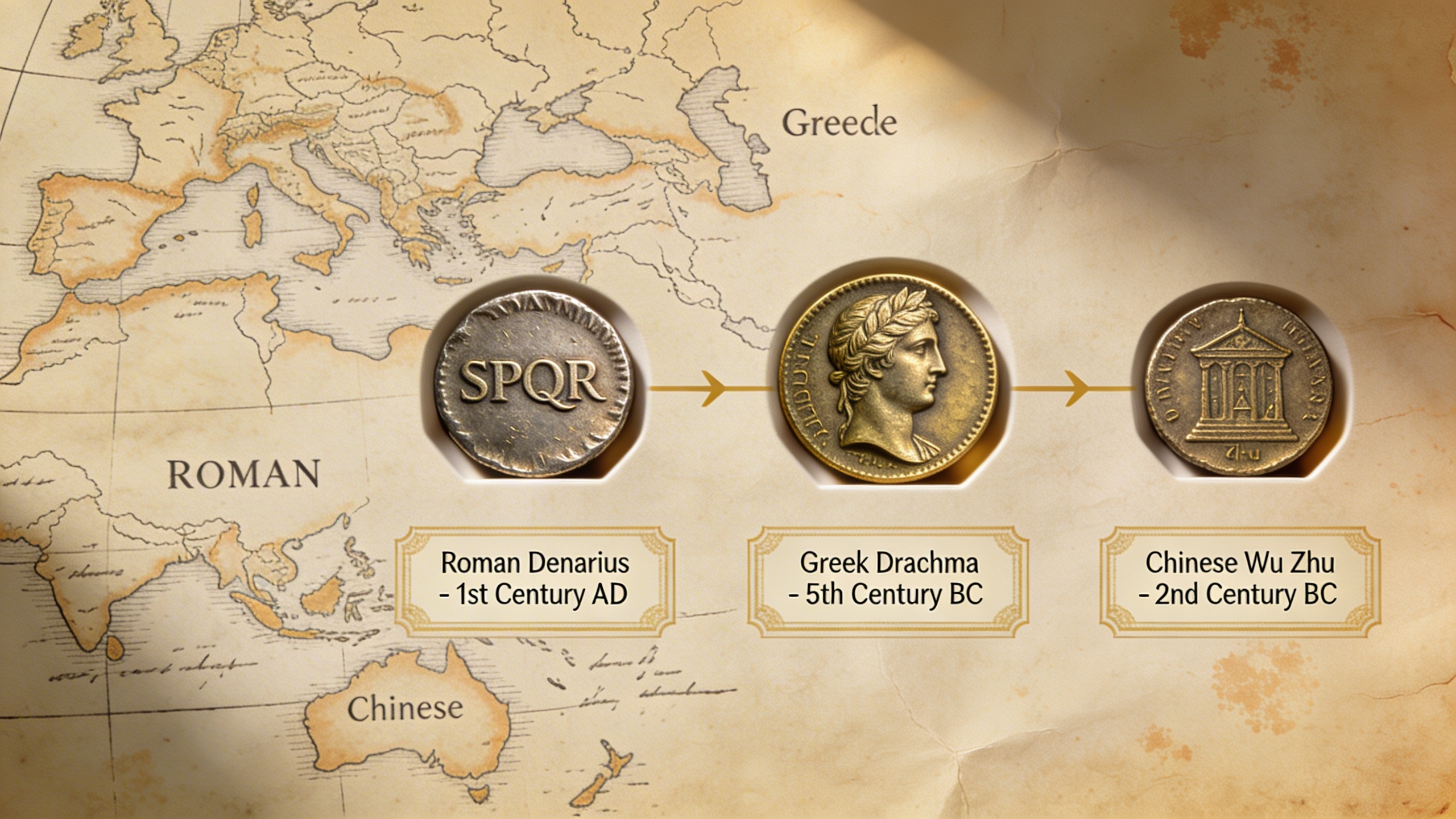
Ancient coins represent the pinnacle of rare coins collecting, offering tangible connections to civilizations that shaped our world. Unlike modern commemorative coin series or collectible 50p coins, ancient specimens carry millennia of history, making them among the most sought-after numismatic treasures. These artifacts provide collectors with authentic pieces of Roman markets, Greek city-states, and Byzantine empires.
Roman and Greek Coin Collecting
Roman and Greek coins form the foundation of ancient numismatics, with specimens ranging from affordable bronze pieces to museum-quality gold aurei. Roman denarii from the Republic period (509-27 BCE) command premium prices, particularly those featuring Julius Caesar or Mark Antony, often selling for $500-$5,000 depending on condition and rarity.
Greek coins showcase exceptional artistry, with Athenian tetradrachms featuring Athena and her owl being among the most recognizable ancient designs. Syracuse decadrachms, considered the most beautiful ancient coins ever minted, can reach six-figure prices for mint coins in exceptional preservation. Provincial Roman coins offer more accessible entry points, with many examples available for $50-$200.
The historical significance of these pieces cannot be overstated. A coin bearing Alexander the Great’s portrait connects collectors directly to one of history’s most influential figures, while Roman imperial coins document the rise and fall of emperors across centuries.
Authentication and Provenance Verification
The ancient coin market faces significant challenges with reproductions and outright fakes. Modern manufacturing techniques can create convincing replicas that fool inexperienced collectors. Professional authentication through services like NGC Ancients or PCGS provides crucial verification, though costs typically range from $35-$100 per coin.
Provenance documentation proves equally important, establishing legal ownership and collection history. Coins lacking proper provenance may face import restrictions or legal challenges, particularly those potentially excavated illegally. Reputable dealers provide detailed provenance records, including previous auction appearances and collection histories.
Physical examination reveals key authentication markers: proper weight, correct metal composition, and appropriate wear patterns consistent with age. Genuine ancient coins display natural patina and circulation marks that modern reproductions struggle to replicate convincingly.
Investment Potential of Ancient Coins
Ancient coins have demonstrated remarkable value appreciation over decades, often outperforming traditional investments. High-grade Roman gold coins have shown consistent 8-12% annual appreciation, while exceptional Greek pieces can achieve even higher returns. The finite supply of ancient coins contrasts sharply with modern mint coins, creating natural scarcity that drives long-term value growth.
Market trends favor coins with clear historical connections and exceptional artistic merit. Coins featuring famous rulers, significant historical events, or outstanding preservation command premium prices. The growing interest in ancient history, fueled by popular media and educational programs, continues expanding the collector base.
Investment-grade ancient coins typically require substantial initial capital, with quality specimens starting around $1,000 and exceptional pieces reaching tens of thousands. However, this market segment offers portfolio diversification benefits and inflation protection that traditional rare coins categories may not match. Serious collectors often view ancient coins as both cultural preservation and sound investment strategy.
Chinese Coins and Asian Numismatics
Chinese numismatics represents one of the world’s oldest and most diverse collecting fields, spanning over 2,500 years of monetary history. From ancient cash coins to modern commemorative issues, Chinese coinage offers collectors access to rare coins that tell the story of dynasties, revolutions, and economic transformation across millennia.
Traditional Chinese Cash Coins
Traditional Chinese cash coins, characterized by their distinctive square holes and bronze composition, dominated Asian commerce for centuries. These ancient coins from the Tang Dynasty (618-907 AD) through the Qing Dynasty (1644-1912) remain highly collectible today. The most sought-after examples include coins from the Song Dynasty, particularly the Xining Zhongbao and Daguan Tongbao issues, which can command prices ranging from $50 to $5,000 depending on condition and rarity.
Cash coins from the Ming Dynasty (1368-1644) present excellent entry points for collectors, with common examples available for $10-30, while rare provincial issues or mint coins can reach several thousand dollars. The intricate calligraphy and regional variations make these pieces particularly appealing to collectors who appreciate both historical significance and artistic merit.
Modern Chinese Commemorative Issues
The People’s Republic of China has produced exceptional commemorative coin series since 1979, rivaling the popularity of British 50p coins among international collectors. Notable series include the 1980 Olympics commemoratives, the Lunar Calendar series, and various cultural heritage issues celebrating Chinese landmarks and traditions.
Modern Chinese commemorative coin values vary significantly based on mintage figures and precious metal content. The 1982 World Cup silver coins, with mintages under 20,000 pieces, now trade for $200-400, while more common issues from the 1990s remain accessible at $30-80. Limited edition proof sets, particularly those featuring traditional Chinese themes, have shown consistent appreciation over the past decade.
Panda Gold and Silver Coins
China’s Panda bullion series, launched in 1982, ranks among the world’s most popular precious metal coins. These annual releases feature changing panda designs, making each year’s issue unique. Silver Pandas contain 30 grams of .999 fine silver, while gold versions range from 1 gram to 1 kilogram.
First-year Panda coins command substantial premiums, with 1982 gold Pandas trading for 50-100% above gold content value. Key dates include the 1983 silver Panda (mintage: 10,000) and 1986 12-ounce silver Panda, both considered essential for serious collectors. Recent years have seen increased international demand, with 2023 and 2024 issues selling out quickly at the China Mint.
Condition remains critical for Panda coin values, as these modern issues are expected to grade MS69 or higher. Collectors should store Pandas in protective capsules to preserve their mirror-like fields and intricate detail work that makes these coins so distinctive in the global precious metals market.
Mint Coins and Franklin Mint Collectibles
Government mints and private companies like the Franklin Mint have created specialized collector markets that bridge the gap between traditional numismatics and modern commemorative coin collecting. These officially produced pieces often command premium prices due to their limited mintages, special packaging, and certificates of authenticity that verify their provenance.
Government Mint Special Releases
National mints regularly produce special edition coins that go far beyond standard circulation pieces. The Royal Mint’s commemorative 50p coins celebrating Olympics, literary characters, and historical events have created an entirely new collecting category. These releases typically feature enhanced finishes, special packaging, and detailed certificates that document the coin’s specifications and significance.
Government mint special releases often include precious metal versions of popular designs. A standard commemorative coin might retail for £10-15, while the silver proof version of the same design could command £50-80. The U.S. Mint’s American Eagle series, Canadian Maple Leafs, and British Britannias represent prime examples of how official mints create collector demand through quality craftsmanship and limited availability.
These mint coins typically appreciate based on precious metal content, artistic merit, and historical significance. Collectors should focus on first-year issues, low mintage releases, and coins marking significant anniversaries or events.
Franklin Mint Company Legacy Products
The Franklin Mint revolutionized private coin production from the 1960s through the 1990s, creating elaborate collector sets that appealed to mainstream audiences. Their approach differed dramatically from traditional rare coins collecting, focusing on themed series like presidential medallions, state commemoratives, and historical recreations.
Franklin Mint products typically featured detailed certificates, custom display cases, and marketing that emphasized their “collectible” nature. Popular series included the Official Bicentennial Medal Collection and various automotive-themed sets. However, unlike ancient coins or government issues, most Franklin Mint pieces derive their value primarily from precious metal content rather than numismatic premium.
Today’s secondary market for Franklin Mint items varies significantly. Sterling silver pieces trade close to melt value ($15-25 for typical medallions), while gold items command premiums of 10-20% above spot price. Rare early issues or error pieces can achieve higher multiples, but most Franklin Mint products should be viewed as precious metal investments rather than traditional collectibles.
Proof Sets and Uncirculated Coins
Understanding the distinction between proof and uncirculated coins is crucial for serious collectors. Proof coins undergo a special minting process using polished dies and planchets, resulting in mirror-like surfaces and frosted design elements. Each coin is struck multiple times under high pressure, creating exceptional detail and finish quality.
Uncirculated coins, while never entering circulation, are produced using standard minting processes. They lack the special finishes of proof coins but often cost significantly less. A typical proof set might retail for $35-50, while the uncirculated version costs $15-25.
Both categories can appreciate substantially over time. The 1995-W Proof Silver Eagle, originally selling for $23, now trades for $3,000-4,000 due to its low mintage of just 30,125 pieces. This demonstrates how even modern mint products can achieve rare coins status through scarcity and collector demand.
Collectors should prioritize coins with original government packaging and certificates, as these significantly impact resale value and authenticity verification in today’s market.
Building and Managing Your Coin Collection
Creating a successful coin collection requires strategic planning, proper care, and smart market decisions. Whether you’re focusing on rare coins from specific eras or building a diverse portfolio spanning multiple categories, effective collection management separates casual hobbyists from serious numismatists.
Investment Strategies for Coin Collectors
Diversification forms the cornerstone of any robust coin investment strategy. Rather than concentrating solely on one category, successful collectors typically spread their investments across multiple areas. Consider allocating portions of your budget to ancient coins for historical significance, modern rare coins for potential appreciation, and popular series like collectible 50p coins for steady market demand.
Market timing plays a crucial role in building value over time. Economic uncertainty often drives precious metal prices higher, making silver and gold coins more attractive. Conversely, stable economic periods may favor commemorative coin series and specialty issues. Monitor auction results and dealer prices quarterly to identify trends in specific categories.
Establish clear collecting goals and budget parameters before making purchases. New collectors should start with lower-value coins to develop expertise before investing in high-grade ancient coins or premium mint coins. Set aside 10-15% of your budget for unexpected opportunities, such as estate sales or dealer liquidations that offer below-market pricing.
Proper Storage and Preservation Techniques
Environmental protection determines whether your coins retain their value or deteriorate over time. Temperature fluctuations and humidity damage coins more than handling, making climate control essential. Maintain storage areas between 65-70°F with 45-55% relative humidity using dehumidifiers or silica gel packets.
Handle coins by their edges only, wearing cotton gloves when examining valuable pieces. Never clean coins with household products or abrasive materials, as this destroys their numismatic value instantly. Professional conservation should only be attempted by certified experts for extremely valuable specimens.
Use appropriate storage materials for different coin types. Plastic holders work well for modern commemorative coin issues, while ancient coins require archival-quality envelopes that allow air circulation. Store mint coins in their original packaging whenever possible, as this packaging often adds premium value.
Create detailed inventory records including purchase dates, prices, and condition notes. Digital photography helps document each coin’s condition over time. Consider professional grading for coins worth over $500, as third-party authentication significantly improves resale value and buyer confidence.
Buying, Selling, and Trading Coins Safely
Reputable dealers provide the safest transaction environment for both buying and selling coins. Look for dealers with Professional Numismatists Guild membership or American Numismatic Association credentials. These organizations maintain ethical standards and dispute resolution procedures that protect collectors.
Major auction houses like Heritage Auctions and Stack’s Bowers handle high-value transactions with detailed lot descriptions and return policies. Online platforms require extra caution—verify seller ratings, request additional photographs, and understand return policies before bidding on rare coins or specialized items.
When selling, obtain multiple appraisals for valuable pieces. Coin shows offer opportunities to compare dealer offers side-by-side, often resulting in better prices than single-dealer transactions. Document all transactions with receipts and certificates of authenticity, as this paperwork significantly impacts future resale value.
Avoid common scams by learning to identify cleaned coins, altered dates, and counterfeit pieces. If a deal seems too good to be true, especially for rare coins or ancient specimens, request additional verification or walk away. Building relationships with trusted dealers provides long-term benefits through early access to quality material and honest market advice.
Frequently Asked Questions
What are the most valuable 50p coins currently in circulation?
The 2009 Kew Gardens 50p is the most valuable in circulation, worth £100-150 due to its low mintage of just 210,000 pieces. Olympic commemoratives from 2011-2012, particularly the Wrestling and Football designs, can fetch £5-15 each. Look for coins with clear, undamaged designs and check the date and specific Olympic sport depicted to identify valuable pieces.
How can I tell if my ancient coins are authentic?
Professional authentication through services like NGC or PCGS is the most reliable method, as they use advanced testing techniques and maintain databases of known fakes. Examine the coin's weight, dimensions, and patina - authentic ancient coins typically show natural aging patterns and wear consistent with their supposed age. Be wary of coins with perfect details, unnatural coloring, or suspiciously low prices, and always request provenance documentation when possible.
Are Franklin Mint coins worth collecting as investments?
Franklin Mint coins generally have limited investment potential, as they were mass-produced collectibles rather than legal tender currency. Their value depends heavily on precious metal content, with silver and gold pieces holding value based on spot prices rather than numismatic premiums. While some limited editions may appreciate modestly, they're better suited for enjoyment collecting rather than serious investment portfolios.
What makes Chinese coins particularly valuable to collectors?
Chinese coins derive value from their rich historical significance spanning thousands of years, with imperial dynasties producing unique designs and characters that tell fascinating stories. Many ancient Chinese coins are extremely rare due to melting during various historical periods, while modern commemoratives benefit from China's growing economy and increased domestic collecting interest. Precious metal content in gold and silver pieces, combined with rising international demand from both Asian and Western collectors, continues to drive values upward.
How should I store my rare coin collection properly?
Use acid-free holders, albums, or certified grading slabs to prevent chemical damage, and store coins in a climate-controlled environment with stable temperature (65-70°F) and low humidity (30-50%). Handle coins only by their edges while wearing cotton gloves, and never clean or polish them as this destroys their value. Invest in a quality safe or safety deposit box for valuable pieces, and maintain detailed inventory records with photographs for insurance purposes.