Most Valuable Baseball Cards from the 1990s: A Complete Collector’s Guide to Hidden Gems and Investment Opportunities
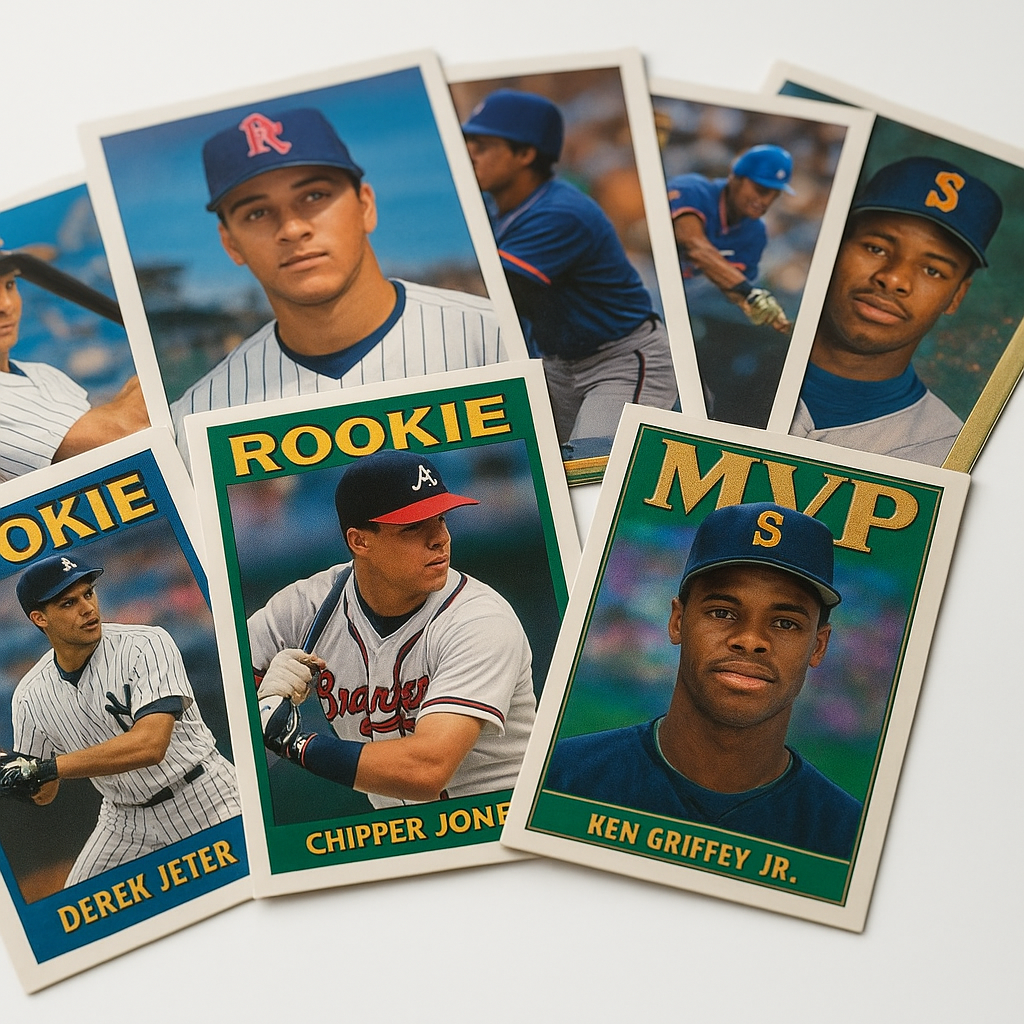
The 1990s baseball card market has undergone a dramatic transformation that would surprise collectors from that era. Once dismissed as an overprinted decade filled with worthless cardboard, the most valuable baseball cards 1990s now command serious attention from investors and collectors alike. Cards that once sat in penny sleeves are now graded gems worth thousands, while rookie cards of Hall of Fame players have skyrocketed in value. The decade that introduced us to premium inserts, refractors, and serial numbering has proven that not all 1990s cards were created equal—some have become the foundation of modern collecting.
This comprehensive guide reveals the valuable baseball cards from the 90s that savvy collectors are targeting today. You’ll discover which 1990 most valuable baseball cards are driving market demand, learn why certain 1990 score baseball cards most valuable specimens are breaking auction records, and understand how rookie cards from stars like Derek Jeter and Chipper Jones have become blue-chip investments. We’ll also explore the most valuable bo jackson baseball cards and other overlooked gems that represent genuine investment opportunities in today’s evolving marketplace.
The Most Valuable 1990s Baseball Cards by Year
The most valuable baseball cards 1990s market offers distinct periods of collecting evolution, each with unique characteristics that shaped card values. Understanding these yearly progressions helps collectors identify the most promising investment opportunities and avoid common pitfalls.
1990-1992: Early Decade Standouts
The early 1990s produced several cards that remain among the most valuable baseball cards from the 90s today. Frank Thomas’s 1990 Leaf #300 leads this period, with pristine PSA 10 examples selling for $8,000-$12,000 in recent auctions. The Big Hurt’s rookie card from Leaf’s premium debut set established the template for modern rookie card collecting.
Among 1990 most valuable baseball cards, the 1990 Score baseball cards most valuable include Frank Thomas (#663), Sammy Sosa (#558), and Larry Walker (#573). Thomas’s Score rookie typically sells for $300-$500 in PSA 10 condition, while Sosa’s commands $150-$250. The 1990 Score set’s wide distribution initially suppressed values, but Hall of Fame inductions have driven steady appreciation.
Bo Jackson’s cards from this period represent some of the most valuable bo jackson baseball cards available. His 1990 Score Supplemental #1T sells for $200-$400 in top condition, while his 1991 Score #383 reaches $100-$200. Jackson’s dual-sport appeal and tragic injury story create sustained collector interest.
Other standout rookies include Juan Gonzalez’s 1990 Leaf #331 ($400-$600 PSA 10) and Bernie Williams’s various 1991 rookies ($50-$150 each). The 1992 Bowman set introduced Derek Jeter’s first mainstream card (#302), now worth $1,500-$2,500 in perfect condition.
1993-1996: The Insert Card Revolution
The mid-1990s transformed baseball card collecting through premium inserts and limited print runs. This period produced some of the decade’s most coveted cards, with values often exceeding base rookies from earlier years.
1993 SP Derek Jeter #279 stands as the crown jewel of 1990s rookies, with PSA 10 examples selling for $15,000-$25,000. The SP set’s foil technology and limited distribution created immediate scarcity that persists today. Alex Rodriguez’s 1994 SP #15 follows at $3,000-$5,000 in top grade.
Insert cards revolutionized the market during this period. The 1993 Finest Refractors introduced chromium technology, with Ken Griffey Jr.’s #110 reaching $2,000-$3,000 PSA 10. Frank Thomas’s 1993 Finest Refractor #103 commands similar prices, while rookie refractors like Mike Piazza (#109) sell for $800-$1,200.
| Card | PSA 9 Value | PSA 10 Value | Key Notes |
|---|---|---|---|
| 1993 SP Derek Jeter #279 | $3,000-$5,000 | $15,000-$25,000 | Iconic rookie card |
| 1994 SP Alex Rodriguez #15 | $800-$1,200 | $3,000-$5,000 | Limited print run |
| 1995 Bowman’s Best Chipper Jones #R1 | $200-$300 | $600-$900 | Refractor technology |
| 1996 Bowman’s Best Kobe Bryant #R23 | $1,500-$2,500 | $4,000-$6,000 | Basketball crossover appeal |
The 1995 Bowman’s Best set introduced affordable refractor parallels, with Chipper Jones (#R1) and Vladimir Guerrero (#R112) leading rookie values. These cards benefit from Hall of Fame credentials and relatively modest print runs.
1997-1999: Premium Sets and Parallels
The late 1990s emphasized ultra-premium products and serial-numbered parallels. While print runs increased overall, the highest-end cards maintained strong values through artificial scarcity and improved card stock quality.
Kerry Wood’s 1998 Bowman Chrome #190 represents the period’s rookie card pinnacle, selling for $1,200-$2,000 in PSA 10 condition. His refractor parallel (#190) reaches $3,000-$5,000, while the rare Gold Refractor commands $8,000-$12,000. Wood’s Rookie of the Year season and 20-strikeout game created immediate collector demand.
1997 Bowman Chrome Scott Rolen #212 emerged as another key rookie, with base versions selling for $300-$500 PSA 10 and refractors reaching $800-$1,200. The Bowman Chrome brand’s consistent quality and collector loyalty support steady appreciation.
Established stars’ inserts dominated this period’s high-end market. Ken Griffey Jr.’s 1997 Donruss Signature Series autographs sell for $2,000-$4,000, while his various refractor parallels command $500-$1,500 depending on scarcity. Mark McGwire’s 1998 home run chase cards experienced dramatic appreciation, with his Topps Chrome #70 reaching $400-$800 in top condition.
For collectors looking to verify authenticity and current market values of these valuable 1990s cards, TCG Radar offers the most accurate card scanning and price checking technology available. The app’s comprehensive database includes detailed information on all major 1990s baseball releases, making it essential for serious collectors navigating this complex market.
The late 1990s also saw increased focus on serial numbering, with cards limited to specific quantities creating immediate collector interest. These artificial scarcity tactics would define early 2000s collecting but had their roots in this transformative period.
1990 Score Baseball Cards: Hidden Value and Key Cards
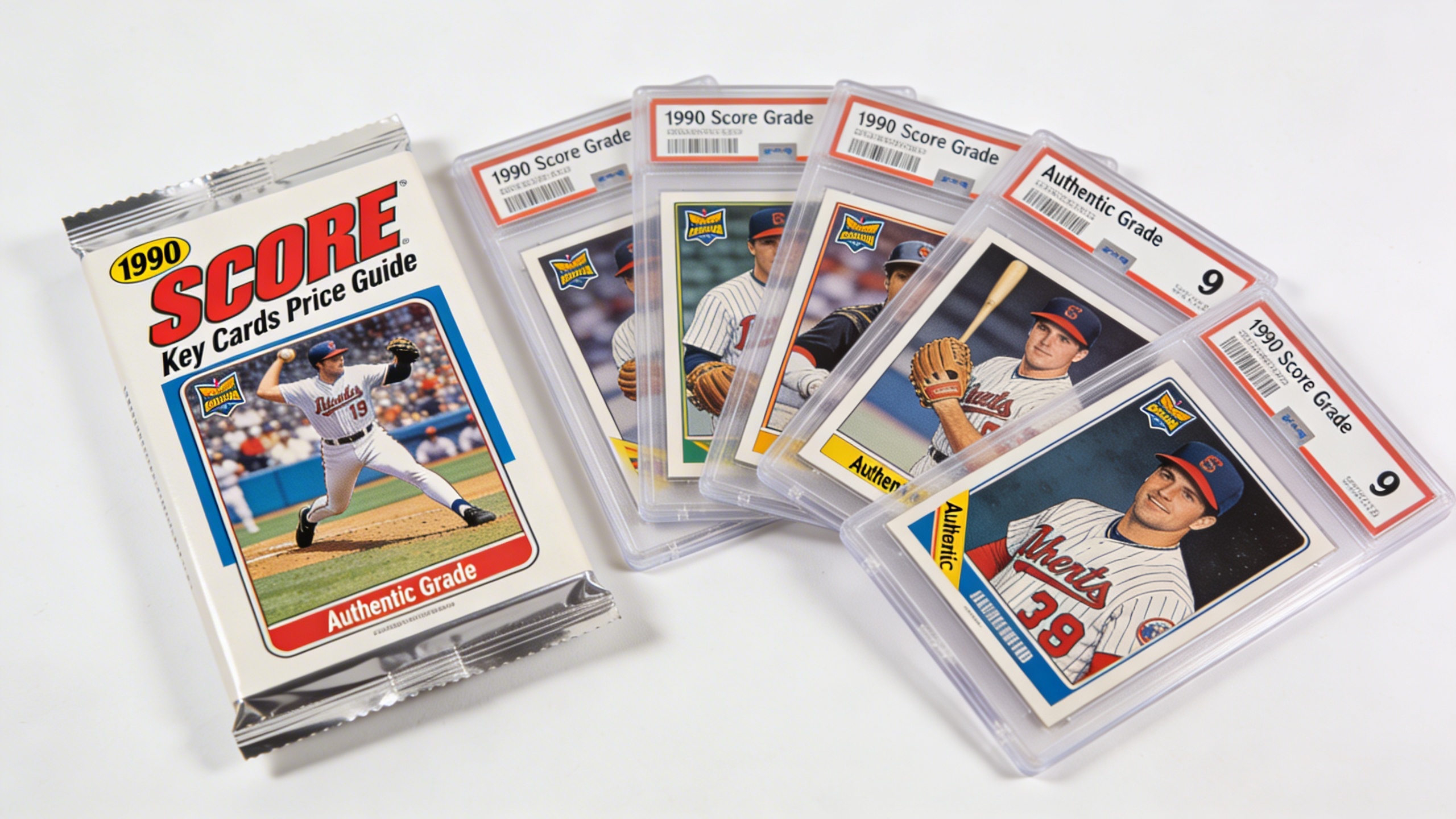
The 1990 Score baseball set represents one of the most overlooked opportunities among most valuable baseball cards 1990s collectors seek. While overshadowed by flagship Topps and Donruss releases, Score’s inaugural set contains several cards that have steadily appreciated in value, particularly high-grade examples and key rookie cards.
Most Valuable 1990 Score Cards
The 1990 Score set consists of 704 cards and features crisp photography with distinctive red borders. Among the 1990 score baseball cards most valuable specimens, several stand out for their investment potential:
| Card | Card Number | PSA 10 Value | Raw Card Value |
|---|---|---|---|
| Frank Thomas RC | #663 | $300-400 | $15-25 |
| Bo Jackson | #697 | $150-200 | $8-12 |
| Larry Walker RC | #573 | $80-120 | $5-8 |
| Juan Gonzalez RC | #560 | $60-90 | $3-6 |
The 1990 Score Frank Thomas rookie card has emerged as the crown jewel of the set. Thomas’s Hall of Fame induction in 2014 significantly boosted demand for his rookie cards across all manufacturers. High-grade examples consistently command premium prices, making this card essential for serious collectors of valuable baseball cards from the 90s.
Bo Jackson and Frank Thomas Rookies
The 1990 Score Bo Jackson card (#697) captures the two-sport superstar at his peak popularity. While not technically a rookie card, Jackson’s 1990 Score appearance coincided with his legendary “Bo Knows” Nike campaign and remains among the most valuable bo jackson baseball cards from any manufacturer that year.
Jackson’s card features him in his Kansas City Royals uniform, and pristine examples have shown remarkable staying power in the market. The card’s value stems from Jackson’s unique cultural impact and the nostalgia factor surrounding his brief but spectacular career.
Frank Thomas’s rookie card represents the most significant long-term investment opportunity in the 1990 Score set. The “Big Hurt” posted incredible numbers throughout the 1990s, winning back-to-back MVP awards in 1993 and 1994. His rookie cards from all manufacturers have appreciated substantially, but the Score version often trades at a discount compared to his Topps and Upper Deck rookies, creating potential upside for savvy collectors.
Error Cards and Variations
The 1990 Score set contains several notable error cards that have become highly sought after by collectors specializing in 1990 most valuable baseball cards variations:
- Jose Uribe (#82) – Features incorrect spelling “Jose Uribe” instead of “Jose Uribe” on some printings
- Juan Gonzalez RC (#560) – Some cards show statistical discrepancies from his minor league career
- Nolan Ryan (#573) – Certain printings contain factual errors in the career statistics section
Error cards from the 1990 Score set typically command 2-3 times the value of corrected versions, particularly when the errors are obvious and well-documented. Collectors should carefully examine cards for printing inconsistencies, as Score’s quality control during their first year resulted in several notable variations.
For collectors looking to identify and value these cards accurately, using a reliable card scanning app like TCG Radar can help distinguish between error cards and standard versions, ensuring you don’t overlook valuable variations in your collection.
The 1990 Score baseball set offers excellent entry points for collectors seeking undervalued cards from the junk wax era. While print runs were substantial, high-grade examples of key cards continue to appreciate, particularly rookie cards of Hall of Fame players and documented error variations.
Rookie Cards That Define 1990s Value
The 1990s produced some of the most valuable baseball cards in modern collecting history, with rookie cards leading the charge in terms of investment potential and market demand. While the decade began with overproduction concerns, certain rookie cards have emerged as cornerstones of valuable baseball cards from the 90s, commanding premium prices that continue to climb with each passing year.
Hall of Fame Rookies from the 90s
The most valuable baseball cards 1990s collectors seek often feature players who would eventually reach Cooperstown. Frank Thomas’s 1990 Topps Traded #41T leads this category, with high-grade examples selling for $3,000-$5,000 in PSA 10 condition. The “Big Hurt” established himself immediately, making his rookie cards essential for serious collectors.
Ken Griffey Jr.’s 1989 Upper Deck #1 technically predates the decade but remained the most sought-after card throughout the early 1990s. However, his 1990 Score #560 offers a more accessible entry point, typically valued at $150-$300 in mint condition. This card represents excellent value among 1990 score baseball cards most valuable options.
| Player | Key Rookie Card | PSA 10 Value | Raw NM Value |
|---|---|---|---|
| Frank Thomas | 1990 Topps Traded #41T | $3,000-$5,000 | $200-$400 |
| Larry Walker | 1990 Leaf #20 | $800-$1,200 | $50-$100 |
| Mike Piazza | 1993 Bowman #511 | $1,500-$2,500 | $100-$200 |
Chipper Jones, Derek Jeter, and Elite Players
The mid-1990s introduced two future Hall of Famers whose rookie cards define modern collecting. Derek Jeter’s 1993 SP #279 stands as one of the most valuable baseball cards from this era, with PSA 10 examples reaching $15,000-$25,000. The card’s scarcity and Jeter’s legendary career create perfect market conditions for sustained growth.
Chipper Jones entered the scene with his 1991 Topps Traded #55T, valued at $400-$800 in top condition. While less expensive than Jeter’s flagship rookie, Jones cards offer solid investment potential given his Hall of Fame induction and the enduring popularity of Atlanta Braves collecting.
Other elite players from the decade include Manny Ramirez (1991 Upper Deck #64), typically worth $100-$200 in PSA 10, and Jim Edmonds (1993 Bowman #511), which remains undervalued at $30-$60 despite his impressive career statistics.
Sleeper Rookie Cards with Potential
Smart collectors focus on undervalued rookies that could appreciate significantly. Carlos Baerga’s 1990 Leaf #300 represents excellent value at $20-$40 for high-grade examples, especially considering his multiple All-Star appearances. Similarly, Ray Lankford’s 1990 Score #634 offers potential upside at current prices of $15-$30.
Among the most valuable bo jackson baseball cards, his 1990 Score football/baseball crossover issues maintain strong collector interest. While primarily known for football, Jackson’s baseball cards from this period benefit from his dual-sport mystique and tragic career arc.
International stars like Hideo Nomo (1995 Topps #156) present interesting opportunities as baseball’s global reach expands. Currently valued at $50-$100 in top condition, Nomo rookies could see increased demand from Japanese collectors and investors.
The grading revolution has dramatically impacted rookie card values from this era. Cards that seemed common in raw form now command significant premiums in PSA 10 or BGS 9.5 condition. For collectors looking to identify and evaluate these cards accurately, TCG Radar provides instant card recognition and current market pricing, making it easier to spot undervalued gems at card shows and online auctions.
When targeting 1990 most valuable baseball cards for investment, focus on Hall of Fame players, maintain realistic grading expectations, and consider long-term potential over short-term gains. The rookie cards from this decade continue to mature as investments, with the best examples showing no signs of slowing down in terms of market appreciation.
Premium Sets and Insert Cards Worth Collecting
The 1990s marked a revolutionary period for premium baseball card production, introducing collectors to high-end sets that command significant values today. These premium releases established the foundation for modern collectible card investing and contain some of the most valuable baseball cards 1990s collectors actively pursue.
Finest, SP, and Ultra Premium Lines
Topps Finest debuted in 1993 as the company’s flagship premium product, featuring chromium technology that created stunning refractor parallels. The 1993 Topps Finest Derek Jeter rookie card (#98) remains one of the most sought-after cards from the decade, with PSA 10 examples selling for $15,000-25,000. The refractor parallel of this same card has reached astronomical prices exceeding $100,000 in gem mint condition.
Upper Deck’s SP line, launched in 1993, introduced foil stamping and premium card stock that elevated the hobby’s production standards. The 1993 SP Derek Jeter rookie (#279) consistently ranks among valuable baseball cards from the 90s, with pristine examples commanding $8,000-12,000. SP Authentic followed in 1995, featuring die-cut designs and limited print runs that created immediate scarcity.
Fleer Ultra represented another premium option, utilizing advanced printing techniques and holographic elements. The 1991 Ultra Update set contains several key rookie cards, including Jeff Bagwell (#U-1), which sells for $300-500 in top condition. These premium sets typically featured lower print runs than base products, contributing to their long-term value retention.
Rare Inserts and Parallels
Insert cards revolutionized collecting during the 1990s, creating chase cards with incredibly low pull rates. The 1996 Topps Chrome Refractors introduced the concept of parallel cards with odds of approximately 1:12 packs. Today, key refractors like the Alex Rodriguez rookie command $2,000-4,000 in PSA 10 condition.
Stadium Club’s Members Only parallel cards from 1991-1992 featured gold foil stamping and were inserted at roughly 1:36 packs. The most valuable bo jackson baseball cards from this era include his 1991 Stadium Club Members Only (#34), which sells for $200-400 depending on condition. These early parallels established the template for modern insert card programs.
Pinnacle’s Artist’s Proofs, introduced in 1992, were limited to approximately 5,000 copies per card and featured distinctive silver foil borders. High-grade examples of star players like Ken Griffey Jr. and Frank Thomas regularly sell for $150-300, making them accessible entry points into premium 1990s collecting.
| Insert Set | Year | Odds | Key Card Value (PSA 10) |
|---|---|---|---|
| Topps Chrome Refractor | 1996 | 1:12 | $2,000-4,000 |
| Stadium Club Members Only | 1991 | 1:36 | $200-400 |
| Pinnacle Artist’s Proof | 1992 | 1:36 | $150-300 |
Autographed and Game-Used Cards
The late 1990s introduced certified autograph and memorabilia cards that fundamentally changed collecting. Upper Deck’s 1997 Game Jersey cards featured actual uniform swatches, while SP Authentic pioneered on-card autographs with clear authentication protocols. These innovations created new categories within the 1990 most valuable baseball cards landscape.
Early autograph cards like the 1996 Leaf Signature Series featured certified signatures with print runs often limited to 2,500 copies or fewer. Hall of Fame players’ autograph cards from these sets typically sell for $300-800, depending on the player’s popularity and card condition.
When evaluating premium 1990s cards, authentication becomes crucial due to the high values involved. Professional grading services like PSA and BGS provide essential verification for both condition and authenticity. For collectors looking to identify and value their premium 1990s cards accurately, TCG Radar offers comprehensive scanning capabilities that can instantly recognize rare inserts and parallels, helping determine current market values.
The 1990 score baseball cards most valuable examples often include premium parallels and inserts that weren’t widely recognized during their original release. Understanding these premium segments helps collectors identify overlooked gems that continue appreciating in today’s market.
Grading and Condition: Maximizing Your 1990s Card Values
The condition of your 1990s baseball cards dramatically impacts their market value, often determining whether a card sells for $10 or $1,000. Understanding grading services and population reports becomes crucial when dealing with the most valuable baseball cards 1990s collectors seek, as even minor condition differences can create significant price gaps.
PSA vs BGS Grading for 90s Cards
PSA and BGS dominate the grading landscape for valuable baseball cards from the 90s, but each service offers distinct advantages. PSA typically commands higher premiums for vintage cards, with their 10-point scale providing straightforward comparisons. A 1993 SP Derek Jeter RC in PSA 10 consistently sells for 15-20% more than the same card in BGS 9.5.
BGS appeals to collectors seeking detailed subgrades, particularly valuable for cards where centering or corners significantly impact appearance. Their Black Label 10 represents perfection across all four subgrades, creating ultra-premium specimens. For cards like the 1990 most valuable baseball cards including the Frank Thomas NNOF, BGS Black Labels command extraordinary premiums—sometimes 300-500% above regular PSA 10 examples.
Turnaround times and costs vary significantly. PSA’s bulk submissions cost $12-15 per card with 3-6 month processing, while BGS charges $20-25 for standard service with similar timeframes. Express services jump to $75-150 per card but deliver results in 10-20 business days.
Population Reports and Rarity
Population reports reveal the true scarcity of high-grade 1990s cards, directly influencing market values. Cards with populations under 50 in PSA 10 typically command significant premiums, while those with 500+ examples face price pressure from supply abundance.
The 1990 Score Baseball Cards most valuable examples demonstrate this principle perfectly. The 1990 Score Frank Thomas RC has over 2,000 PSA 10 examples, keeping prices around $100-150. Conversely, the 1990 Score Bo Jackson has fewer than 200 PSA 10s, pushing values toward $300-500 for most valuable Bo Jackson baseball cards.
Population trends shift constantly as collectors submit more cards. Early 1990s inserts like 1991 Stadium Club Members Only cards maintain low populations due to their original scarcity, while base cards from high-production sets continue growing in graded populations.
Raw vs Graded Value Differences
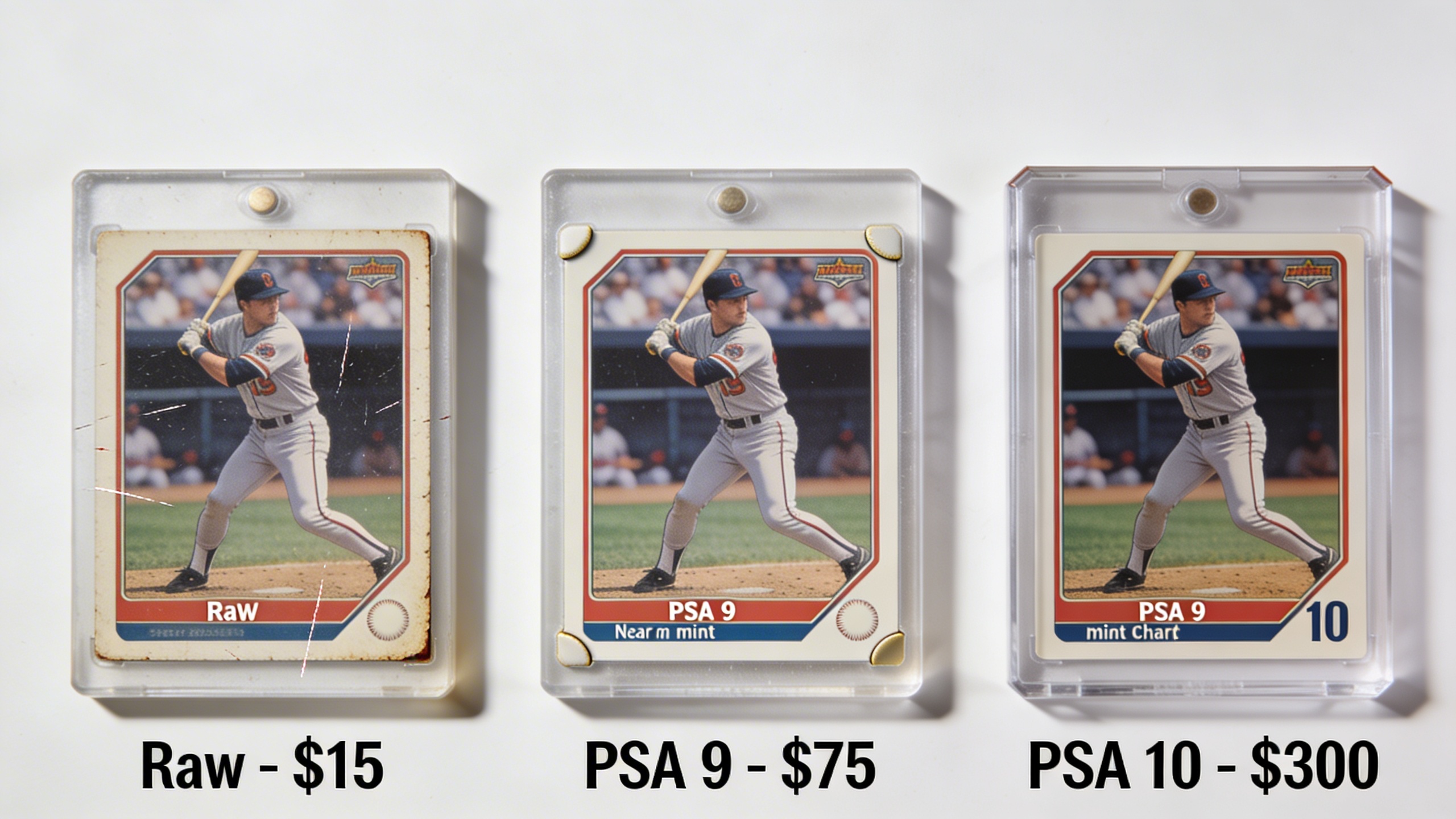
The decision to grade versus selling raw depends on several factors: card condition, market demand, and population scarcity. High-grade candidates showing sharp corners, perfect centering, and clean surfaces typically benefit from professional grading, especially for key rookie cards and scarce inserts.
Raw cards in apparent mint condition often sell for 20-40% of their graded counterparts’ values. A raw 1993 SP Jeter might bring $800-1,200, while PSA 10 examples reach $2,500-3,500. However, grading costs and the risk of receiving lower grades must factor into decisions.
For accurate condition assessment before grading decisions, collectors increasingly rely on digital tools. TCG Radar provides instant card identification and current market values, helping collectors make informed grading choices by comparing raw and graded price differences in real-time.
Cards showing any visible wear, off-centering, or surface issues rarely justify grading costs unless they’re extremely rare or historically significant. Focus grading budgets on apparent mint specimens of key rookies, low-population inserts, and error cards with strong market demand.
Market Trends and Investment Potential
Current Market Performance
The market for most valuable baseball cards 1990s has experienced significant volatility over the past three years, with distinct patterns emerging across different player categories. Hall of Fame rookie cards from the decade have shown remarkable resilience, with Derek Jeter’s 1993 SP Foil maintaining values between $8,000-$15,000 in PSA 10 condition. Meanwhile, Frank Thomas rookies from 1990 have surged 40% since 2022, particularly his 1990 Leaf card which now commands $800-$1,200 in pristine condition.
Insert cards and premium parallels have outperformed base cards consistently. The 1993 Finest Refractors continue appreciating at 15-20% annually, while 1990 Score baseball cards most valuable examples like the Bo Jackson card have maintained steady $50-$100 price points for high-grade specimens. This stability reflects the enduring appeal of iconic players from the era, even as production numbers were historically high.
Modern tools like TCG Radar have revolutionized how collectors track these market movements, providing real-time price data and helping identify undervalued cards before market corrections occur.
Future Outlook for 1990s Cards
Generational collecting patterns strongly favor 1990s cards entering a golden period between 2025-2030. Collectors who grew up during this era are now reaching peak earning years, creating sustained demand for valuable baseball cards from the 90s featuring their childhood heroes. This demographic shift mirrors the boom experienced by 1980s cards in the early 2010s.
Most valuable bo jackson baseball cards exemplify this trend, as his cultural impact transcends traditional baseball collecting. His 1990 Score and Pro Set cards continue attracting crossover collectors from football and pop culture enthusiasts, suggesting sustained long-term demand regardless of traditional baseball card market fluctuations.
The Hall of Fame election cycle will significantly impact 1990s card values through 2026. Players like Todd Helton and Billy Wagner entering Cooperstown could trigger 25-50% appreciation in their rookie cards. Smart collectors are already positioning themselves ahead of these announcements.
Buying and Selling Strategies
Successful investment timing requires understanding seasonal patterns and market cycles. Spring training generates renewed interest in 1990 most valuable baseball cards, making February-March optimal selling windows. Conversely, late fall presents buying opportunities as casual collectors liquidate holdings before year-end.
Focus acquisition strategies on PSA 9 examples of key rookies rather than chasing PSA 10 specimens at premium prices. The grade differential often represents 3-4x price differences while visual quality remains exceptional. This approach maximizes portfolio diversity within budget constraints.
Regional market variations offer arbitrage opportunities. Cards featuring players with strong local followings often command premiums in their home markets. A Ken Griffey Jr. rookie might sell for 15-20% more in Seattle than nationally, while Texas Rangers cards perform better in Dallas-Fort Worth markets.
Diversification across multiple years and sets reduces risk exposure. Rather than concentrating entirely on 1993 rookies, balance holdings with 1990-1992 cards and premium inserts. This strategy captures appreciation across the entire decade while minimizing impact from individual player performance declines.
Market predictions for 2026 suggest continued growth for authenticated high-grade examples, with ungraded cards facing increasing difficulty finding buyers. The authentication trend will likely accelerate, making professional grading essential for serious collectors and investors targeting maximum returns.
How to Identify and Authenticate Valuable 1990s Cards
Authenticating most valuable baseball cards 1990s requires careful examination of specific features that counterfeiters often struggle to replicate perfectly. With valuable baseball cards from the 90s commanding premium prices, knowing how to spot fakes protects your investment and ensures you’re purchasing genuine collectibles.
Spotting Counterfeits and Reprints
Common counterfeiting techniques target high-value cards like the 1993 SP Derek Jeter (#279) and most valuable bo jackson baseball cards from the early 1990s. Counterfeiters typically use inferior printing methods that produce telltale signs: colors appear oversaturated or washed out, text looks fuzzy or pixelated, and card stock feels either too thin or unnaturally thick compared to authentic examples.
Reprints pose another challenge, especially with 1990 score baseball cards most valuable selections. Licensed reprints from companies like Topps Archives clearly state “reprint” on the card, but unlicensed reproductions may not. Check for copyright dates that don’t match the original release year and examine the card’s overall feel—reprints often use different cardboard composition than period-correct stock.
Key Authentication Features
Authentic 1990s cards display specific characteristics that verify their legitimacy. Original card stock from this era has a distinctive weight and texture that experienced collectors recognize immediately. Examine the printing quality under magnification—genuine cards show consistent dot patterns in the printing process, while counterfeits often display irregular or blotchy patterns.
For 1990 most valuable baseball cards, check the foil stamping on premium inserts. Authentic foil appears crisp and adheres properly to the card surface, while counterfeit foil may peel, appear dull, or show inconsistent application. The card’s cutting should be precise with clean, straight edges—poor cutting quality often indicates reproduction.
Using a reliable card identification tool like TCG Radar can help verify card authenticity by comparing your card against a database of verified examples, making it easier to spot discrepancies in printing, coloring, or design elements.
Where to Buy Authentic Cards
Purchase from established dealers with strong reputations and return policies. Major auction houses like Heritage Auctions provide detailed photographs and authenticity guarantees for high-value lots. Online marketplaces like eBay offer buyer protection, but exercise caution—examine seller feedback carefully and request additional photos if needed.
Local card shops with long-standing community presence often provide the best authentication support, as experienced dealers can spot fakes immediately. Avoid deals that seem too good to be true, especially for key rookie cards or rare inserts. When purchasing cards valued over $100, consider buying only graded examples from PSA or BGS, as these companies authenticate cards before encapsulation.
Always request detailed photos showing the card’s surface, corners, and edges before purchasing online. Legitimate sellers readily provide multiple angles and close-up shots of valuable cards.
Frequently Asked Questions
What are the most valuable baseball cards from the 1990s?
The most valuable 1990s baseball cards include Derek Jeter's 1993 SP Foil rookie ($5,000-$15,000), Chipper Jones' 1991 Topps rookie ($500-$2,000), and Pedro Martinez's 1992 Bowman rookie ($300-$1,500). Other high-value cards include Frank Thomas rookies, Ken Griffey Jr. inserts like the 1997 Donruss Signature Series, and rare error cards or short-printed variations. Premium inserts and autographed cards from this era can command thousands of dollars in mint condition.
Are 1990 Score baseball cards worth anything?
Most 1990 Score baseball cards are worth minimal amounts due to overproduction, but certain cards have significant value. Key rookies like Frank Thomas (#663) can be worth $50-$200 in high grades, while the Bo Jackson error card and other variations command premium prices. High-grade examples (PSA 10) of star players and rookies are where the real value lies in this set.
Which 1990s baseball rookie cards are most valuable?
The most valuable 1990s rookie cards include Derek Jeter (1993 SP Foil - $5,000+), Chipper Jones (1991 Topps - $500-$2,000), and Pedro Martinez (1992 Bowman - $300-$1,500). Other valuable rookies include Frank Thomas (1990 Topps/Score - $50-$300), Mike Piazza (1993 Bowman - $200-$800), and Mariano Rivera (1992 Bowman - $400-$1,200). Condition and grading significantly impact these values.
How much are Bo Jackson baseball cards from the 1990s worth?
Bo Jackson's 1990s baseball cards vary widely in value, with his 1990 Score error card (wrong back) being worth $100-$500 depending on condition. His regular 1990 Score and Topps cards are worth $5-$25 in mint condition, while high-grade examples can reach $50-$100. Special inserts and autographed cards from the mid-1990s can command $200-$1,000+ depending on rarity and condition.
Should I get my 1990s baseball cards graded?
Grading 1990s baseball cards makes financial sense for high-value rookies, rare inserts, or cards in exceptional condition where grading costs ($20-$50) are justified by potential value increases. Cards worth less than $100 in raw condition typically don't benefit from grading unless they're in perfect condition. Focus on grading Hall of Fame rookies, error cards, and premium inserts where a high grade can significantly multiply the card's value.