
The trading card grading landscape has evolved dramatically, with SGC grading and CGC grading emerging as two powerhouse companies that dominate different corners of the collectibles market. While SGC has built its reputation as the gold standard for vintage sports cards with over three decades of experience, CGC has leveraged its comic book grading expertise to become a formidable force in trading card games and modern collectibles. Understanding the nuances between these grading giants isn’t just academic—it directly impacts your collection’s value, marketability, and long-term investment potential.
Choosing between SGC and CGC requires more than simply picking the most recognizable name. Each company brings distinct advantages in pricing structures, turnaround times, and market acceptance across different card categories. SGC grading costs and CGC grading cost vary significantly based on declared value and service levels, while their grading philosophies can yield different results for identical cards. Whether you’re submitting a 1952 Topps Mickey Mantle or a first-edition Charizard, this comprehensive comparison will equip you with the knowledge to make informed grading decisions that maximize your collection’s potential and align with your specific collecting goals.
- Understanding SGC and CGC: Company Backgrounds and Specializations
- SGC’s Sports Card Heritage and Evolution
- CGC’s Comic Book Dominance and TCG Expansion
- Market Positioning and Collector Perception
- Grading Standards and Scale Comparison
- SGC’s 10-Point Grading Scale Breakdown
- CGC’s Grading Criteria and Numbering System
- Key Differences in Grade Assignment Philosophy
- Pricing Structure and Cost Analysis
- SGC Grading Costs and Service Tiers
- CGC Pricing for Cards vs Comics
- Value Proposition and Cost-Effectiveness
- Processing Times and Service Speed Comparison
- SGC Turnaround Times by Service Level
- CGC Processing Speed and Express Options
- Seasonal Variations and Capacity Issues
- Card Types and Compatibility
- Sports Cards: SGC’s Specialty vs CGC’s Approach
- Trading Card Games: Pokemon, Magic, Yu-Gi-Oh Coverage
- Vintage Cards and Special Considerations
- Holder Quality and Label Design
- SGC Slab Construction and Durability
- CGC Holder Features and Protection
- Label Information and Aesthetic Appeal
- Market Value and Resale Impact
- SGC vs CGC Premium in Secondary Markets
- Auction Results and Price Comparisons
- Future Trends and Market Evolution
Understanding SGC and CGC: Company Backgrounds and Specializations
The collectibles grading landscape has been shaped by two distinct companies that emerged at the turn of the millennium, each bringing unique expertise to card authentication and grading. While both SGC and CGC have evolved into comprehensive grading services, their foundational differences continue to influence their market positioning and collector preferences today.
SGC’s Sports Card Heritage and Evolution
Sports Card Guaranty (SGC) launched in 1998 with a laser focus on vintage sports cards, establishing itself as a specialist in pre-war and classic baseball cards. Founded by collectors who understood the nuances of early 20th-century cardboard, SGC grading quickly gained respect for its conservative approach to condition assessment and detailed authentication processes.
The company built its reputation by expertly handling iconic sets like 1909-11 T206, 1952 Topps, and 1933 Goudey, developing specialized knowledge in paper quality, printing variations, and period-appropriate wear patterns. SGC’s early success stemmed from addressing the specific needs of vintage sports card collectors who required more nuanced grading than existing services provided.
Over the past two decades, SGC has expanded beyond vintage baseball to include modern sports cards, non-sports entertainment cards, and even some trading card games. However, their core identity remains rooted in sports collectibles, with SGC grading costs typically ranging from $20-50 for standard service levels, making them competitive for high-value vintage submissions.
CGC’s Comic Book Dominance and TCG Expansion
Certified Guaranty Company (CGC) entered the market in 2000, revolutionizing comic book collecting through standardized grading practices. CGC established the 10-point grading scale that became industry standard, bringing transparency and consistency to a market previously dominated by subjective condition assessments.
CGC’s success in comics created a blueprint for expansion into related collectibles. In 2020, the company launched CGC Trading Cards, applying their proven methodologies to Pokemon, Magic: The Gathering, and sports cards. This expansion leveraged CGC’s established brand recognition and grading infrastructure while adapting to the unique characteristics of trading card materials and conditions.
The company’s cgc grading cards service has gained significant traction, particularly among modern card collectors and investors who value CGC’s detailed holder design and comprehensive grading notes. CGC grading cost structures typically start around $25 for standard submissions, with expedited services commanding premium pricing.
Market Positioning and Collector Perception
Today’s grading market reveals distinct collector preferences based on card type and collecting philosophy. SGC maintains approximately 15-20% market share in sports card grading, with particularly strong representation in vintage markets where their expertise commands premium recognition. Many vintage dealers and auction houses specifically request SGC holders for pre-1980 material.
CGC holds roughly 10-15% of the overall card grading market but dominates specific segments, particularly modern Pokemon and entertainment cards. Their comic book heritage appeals to collectors who appreciate detailed condition analysis and protective holder design. The company’s rapid growth in trading card games reflects their ability to adapt grading standards to different collectible categories.
Collector perception often aligns with specialization: vintage sports card enthusiasts frequently prefer SGC’s conservative grading and historical expertise, while modern card investors gravitate toward CGC’s detailed population reports and market transparency. Both companies have developed loyal followings, with some collectors choosing grading services based on specific card categories rather than universal preference.
For collectors managing large collections across multiple categories, tools like TCG Radar can help identify which cards might benefit most from professional grading by providing accurate market valuations and condition assessments before submission.
Understanding these foundational differences helps collectors make informed decisions about which grading service best aligns with their collecting goals and the specific cards in their collection.
Grading Standards and Scale Comparison
Understanding the grading standards and methodologies used by SGC and CGC is crucial for collectors making informed decisions about card authentication and valuation. Both companies employ rigorous evaluation processes, but their approaches to assessing card condition differ in several important ways that can significantly impact your collection’s value and marketability.
SGC’s 10-Point Grading Scale Breakdown
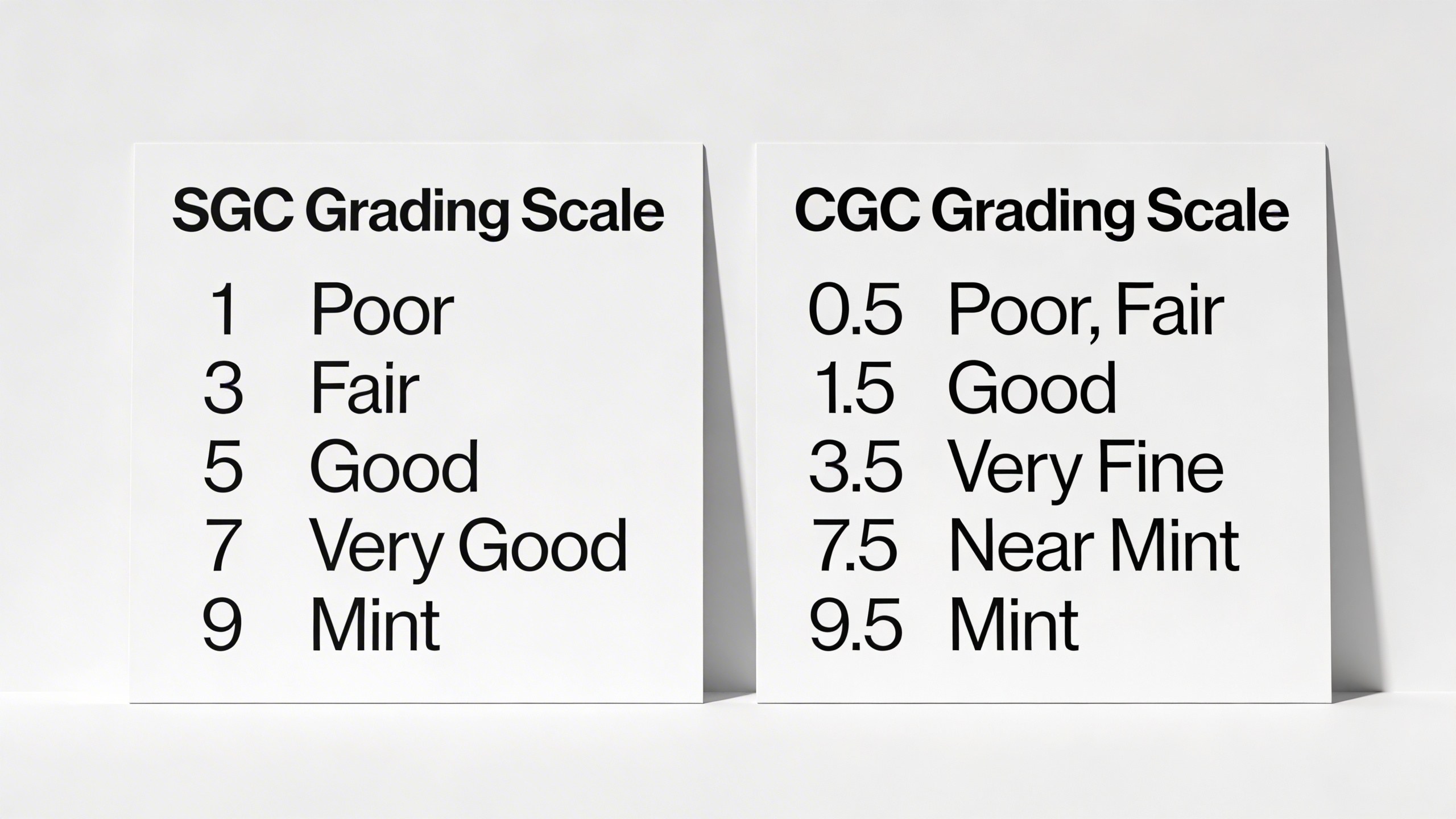
SGC grading utilizes a traditional 10-point scale that has remained consistent since the company’s founding. The scale ranges from SGC 1 (Poor) to SGC 10 (Gem Mint), with half-point grades available for cards scoring between 1.5 and 8.5. This granular approach allows for more precise condition assessment, particularly in the mid-grade range where many vintage cards fall.
SGC’s evaluation focuses heavily on four primary factors: centering, corners, edges, and surface quality. For an SGC 10, centering must be within 55/45 or better on both front and back, corners must be sharp with no visible wear, edges need to be clean and free from chipping, and the surface must show no printing defects or handling marks. SGC 9 cards allow for slightly off-center positioning (60/40) and minor corner touches that are barely visible.
Population reports from SGC show that approximately 2-3% of submitted modern cards receive the coveted SGC 10 grade, while vintage cards from the 1960s and earlier see SGC 10 rates below 0.5%. This data reflects SGC’s reputation for maintaining strict standards, particularly for older cardboard that has survived decades of potential handling and storage issues.
CGC’s Grading Criteria and Numbering System
CGC grading cards follows a similar 10-point scale but with distinct evaluation criteria that reflect the company’s comic book grading heritage. CGC uses whole number grades from 1.0 to 10.0, with increments of 0.5 points. Their grading philosophy emphasizes technical precision and consistency across all collectible categories.
The CGC system places particular emphasis on surface quality and print registration, areas where their comic book expertise translates well to trading cards. A CGC 9.8 card must have near-perfect centering (typically 52/48 or better), razor-sharp corners with no visible wear under magnification, pristine edges, and flawless surface quality with no printing anomalies. CGC 9.6 allows for slightly more tolerance in centering (55/45) and may show minimal corner wear visible only under close inspection.
Current cgc grading cost structures reflect their premium positioning, with standard submissions typically running $20-30 per card for modern issues. Population data indicates that CGC awards 9.8 and 10.0 grades to approximately 8-12% of modern card submissions, though this varies significantly by product and era.
Key Differences in Grade Assignment Philosophy
The most significant philosophical difference between these services lies in their tolerance for manufacturing defects versus handling wear. SGC tends to be more forgiving of minor print defects that occurred during the original manufacturing process, viewing them as period-correct characteristics rather than condition issues. Conversely, CGC often treats print registration problems and similar factory flaws as grade-limiting factors.
Centering standards also differ meaningfully between the two services. While both companies measure centering precisely, SGC’s standards for their top grades are generally more stringent than CGC’s equivalent grades. An SGC 10 requires tighter centering tolerances than a CGC 10.0, which can result in the same card receiving different grades from each service.
For collectors tracking their investments, using TCG Radar can help monitor population reports and market values across both grading services, providing real-time insights into how grading choices impact card values.
Surface evaluation represents another area of divergence. SGC’s graders often focus more heavily on the card’s overall eye appeal and how defects impact the visual presentation, while CGC employs more technical criteria that may penalize cards for flaws that don’t significantly detract from appearance. This difference becomes particularly pronounced when evaluating vintage cards with age-appropriate wear patterns.
Understanding these philosophical differences helps explain why sgc grading costs and cgc grading cost structures vary, and why the same card might receive different grades from each service. The choice between services should align with your collecting goals, target market preferences, and the specific characteristics of your cards.
Pricing Structure and Cost Analysis
Understanding the financial investment required for professional grading is crucial when choosing between SGC and CGC services. Both companies have refined their pricing structures in 2026 to better serve collectors across different budget ranges and submission volumes.
SGC Grading Costs and Service Tiers
SGC grading operates on a straightforward tier system based on declared card value and desired turnaround time. The Economy service, priced at $18 per card for items valued up to $499, offers 30-45 business day processing and remains their most popular option for vintage commons and mid-tier cards. The Standard tier costs $30 per card for values up to $2,499 with 15-20 business day turnaround, while the Express service jumps to $75 per card for 5-7 business day processing.
SGC grading costs become more attractive with bulk submissions. Members submitting 50+ cards receive a 15% discount, while submissions over 100 cards qualify for 20% savings. The company’s annual membership at $99 provides additional benefits including free return shipping on orders over $300 and priority customer service.
CGC Pricing for Cards vs Comics
CGC grading operates differently, with separate pricing structures for trading cards versus their traditional comic book services. For cards, CGC’s Standard tier starts at $25 per card for items valued up to $400, with 25-30 business day processing. Their Fast Track service costs $40 per card with 12-15 business day turnaround, while Express service reaches $85 per card for 5-7 business days.
CGC grading cards benefits from volume discounts starting at 20 submissions, offering 10% savings, escalating to 25% discounts for submissions exceeding 200 cards. Their Collectors Society membership ($149 annually) provides enhanced submission tracking, exclusive holder designs, and reduced shipping costs on qualifying orders.
| Service Level | SGC Cost | CGC Cost | Turnaround Time |
|---|---|---|---|
| Economy/Standard | $18 | $25 | 25-45 days |
| Fast Track | $30 | $40 | 12-20 days |
| Express | $75 | $85 | 5-7 days |
Value Proposition and Cost-Effectiveness
Beyond base grading fees, collectors must factor in shipping costs ranging from $15-45 depending on submission size and insurance requirements. Both companies mandate insurance for declared values exceeding $100, adding 1-3% of total submission value to overall costs.
The cgc grading cost structure favors higher-value submissions due to their percentage-based insurance model, while sgc grading costs remain more predictable for budget-conscious collectors. For cards valued under $200, SGC typically offers better cost-effectiveness, while CGC’s premium positioning may justify higher fees for significant vintage pieces or modern chase cards.
ROI considerations vary significantly based on card type and market conditions. Modern sports cards often see 2-3x value increases with high grades, while vintage cards may experience 5-10x multipliers. When evaluating submissions, consider using TCG Radar to assess current market values and determine if grading costs align with potential returns. The app’s comprehensive price tracking helps identify cards where professional grading investment makes financial sense.
Collectors focusing on long-term portfolio growth should prioritize service quality over marginal cost differences, as the premium from top-tier grading often outweighs initial savings from budget alternatives.
Processing Times and Service Speed Comparison
Understanding processing times is crucial when choosing between SGC and CGC for your card grading needs. Both companies offer multiple service tiers with varying speeds and costs, but their actual turnaround times can differ significantly based on submission volume and seasonal demand.
SGC Turnaround Times by Service Level
SGC grading offers four primary service levels with distinct timeframes. Their Economy service typically takes 45-60 business days and represents the most cost-effective option for collectors submitting common cards. The Standard service reduces wait times to 20-30 business days at a moderate price increase.
For collectors needing faster results, SGC’s Express service delivers grades in 10-15 business days, while their Super Express option guarantees 5-7 business day turnaround. However, these expedited services come with substantially higher sgc grading costs, often 3-5 times the Economy rate. SGC has consistently met their published timeframes throughout 2024, making them reliable for collectors planning around specific deadlines.
CGC Processing Speed and Express Options
CGC grading cards follows a similar tiered structure but with different naming conventions and timeframes. Their Standard service typically processes submissions within 30-45 business days, positioning it between SGC’s Economy and Standard offerings. CGC’s Fast Track service reduces wait times to 15-20 business days.
The company’s Express service promises 10-12 business day turnaround, while their Walkthrough service offers same-day grading at major conventions and events. CGC grading cost increases substantially for faster services, with Express submissions often costing 4-6 times the Standard rate. CGC has improved their consistency significantly since 2023, though they occasionally experience delays during high-volume periods.
Seasonal Variations and Capacity Issues
Both companies experience predictable seasonal fluctuations that affect processing times. The period from November through February typically sees the longest delays as collectors submit holiday acquisitions and prepare for tax season sales. During these peak months, Standard services can extend 20-30% beyond published timeframes.
Summer months generally offer the fastest processing, with both SGC and CGC often completing submissions ahead of schedule. Major card releases, such as new Pokémon sets or significant sports card products, can create temporary backlogs that impact all service levels.
SGC has invested heavily in facility expansion and staffing, allowing them to maintain more consistent turnaround times during peak periods. CGC has similarly upgraded their operations but occasionally struggles with capacity during major submission waves.
Both companies provide tracking systems for monitoring submission progress. SGC’s online portal offers detailed status updates, while CGC provides email notifications at key processing milestones. For collectors managing valuable submissions, using a card scanning app like TCG Radar before shipping helps document card conditions and values for insurance purposes.
Planning submissions around these seasonal patterns can save both time and money. Submitting during slower periods in late spring or early fall often results in faster processing at standard rates, while avoiding the premium costs associated with expedited services during busy seasons.
Card Types and Compatibility
Understanding which grading service excels with specific card types can significantly impact your grading decisions and final card values. Both SGC and CGC have developed distinct strengths across different categories, making the choice between them dependent on your collection’s composition.
Sports Cards: SGC’s Specialty vs CGC’s Approach
SGC grading has built its reputation primarily on sports card authentication and grading, with particular expertise in vintage baseball cards from the 1950s through 1980s. Their graders possess deep knowledge of printing variations, paper stock differences, and era-specific manufacturing quirks that affect cards like the 1952 Topps Mickey Mantle or 1986 Fleer Basketball sets. SGC’s database contains detailed information on over 750,000 different sports cards, enabling precise identification of subtle variations that impact value.
CGC grading cards from the sports category represents a newer but rapidly growing segment of their business. While they lack SGC’s decades of sports card specialization, CGC has invested heavily in hiring experienced sports card graders and developing comprehensive databases. Their modern approach includes detailed imaging technology that captures card surfaces at higher resolution than traditional methods, particularly beneficial for detecting alterations in high-value vintage cards.
Trading Card Games: Pokemon, Magic, Yu-Gi-Oh Coverage
CGC dominates the trading card game market through their extensive experience with collectible card games. They grade Pokemon cards from all Japanese and English sets, including promotional cards, error cards, and tournament prizes. CGC’s graders understand the nuances of Pokemon card printing, such as the centering standards that differ between Wizards of the Coast and Pokemon Company International eras.
For Magic: The Gathering cards, CGC grading cost structures accommodate both individual cards and complete sets. They maintain expertise in identifying Alpha, Beta, and Unlimited Edition differences, plus knowledge of printing variations across different facilities. CGC has graded notable cards including Black Lotus Alpha examples that have sold for over $500,000.
Yu-Gi-Oh cards present unique challenges due to their smaller size and foil treatments. CGC has developed specific holders and grading criteria for these cards, while SGC grading costs for Yu-Gi-Oh cards remain higher due to their limited experience with the format.
Vintage Cards and Special Considerations
Both services handle vintage cards differently based on their historical expertise. SGC excels with pre-war tobacco cards, candy cards, and early Topps releases. Their authentication process for cards like 1909-11 T206 Honus Wagner includes detailed analysis of paper composition, printing methods, and known reprints or counterfeits.
Size limitations affect both services, though with different parameters. SGC accommodates standard trading cards up to 3.5″ x 5.5″, while CGC grading handles cards up to 4″ x 6″. For oversized cards like 1971 Topps Super or jumbo rookie cards, both companies offer special services with modified holders and adjusted sgc grading costs.
When dealing with valuable vintage cards requiring authentication, using TCG Radar before submission helps verify card details and current market values. The app’s database includes pricing information for both SGC and CGC graded examples, helping you make informed decisions about which service might yield better returns.
| Card Type | SGC Strength | CGC Strength | Recommended Service |
|---|---|---|---|
| Vintage Sports (Pre-1980) | Extensive database, authentication expertise | Advanced imaging technology | SGC |
| Modern Sports | Traditional grading standards | Consistent population reports | Either |
| Pokemon/TCG | Limited experience | Market leader, specialized knowledge | CGC |
| Oversized Cards | Custom holders available | Standard oversized service | CGC |
The cgc grading cost structure includes specific pricing tiers for different card categories, while SGC maintains more uniform pricing across card types. Consider your collection’s composition when choosing between services, as specialization often translates to better grades and higher resale values.
Holder Quality and Label Design
The physical protection and aesthetic appeal of graded card holders play crucial roles in long-term preservation and collection display. Both SGC and CGC have developed distinct approaches to slab construction, with each offering unique advantages for different collector preferences and storage requirements.
SGC Slab Construction and Durability
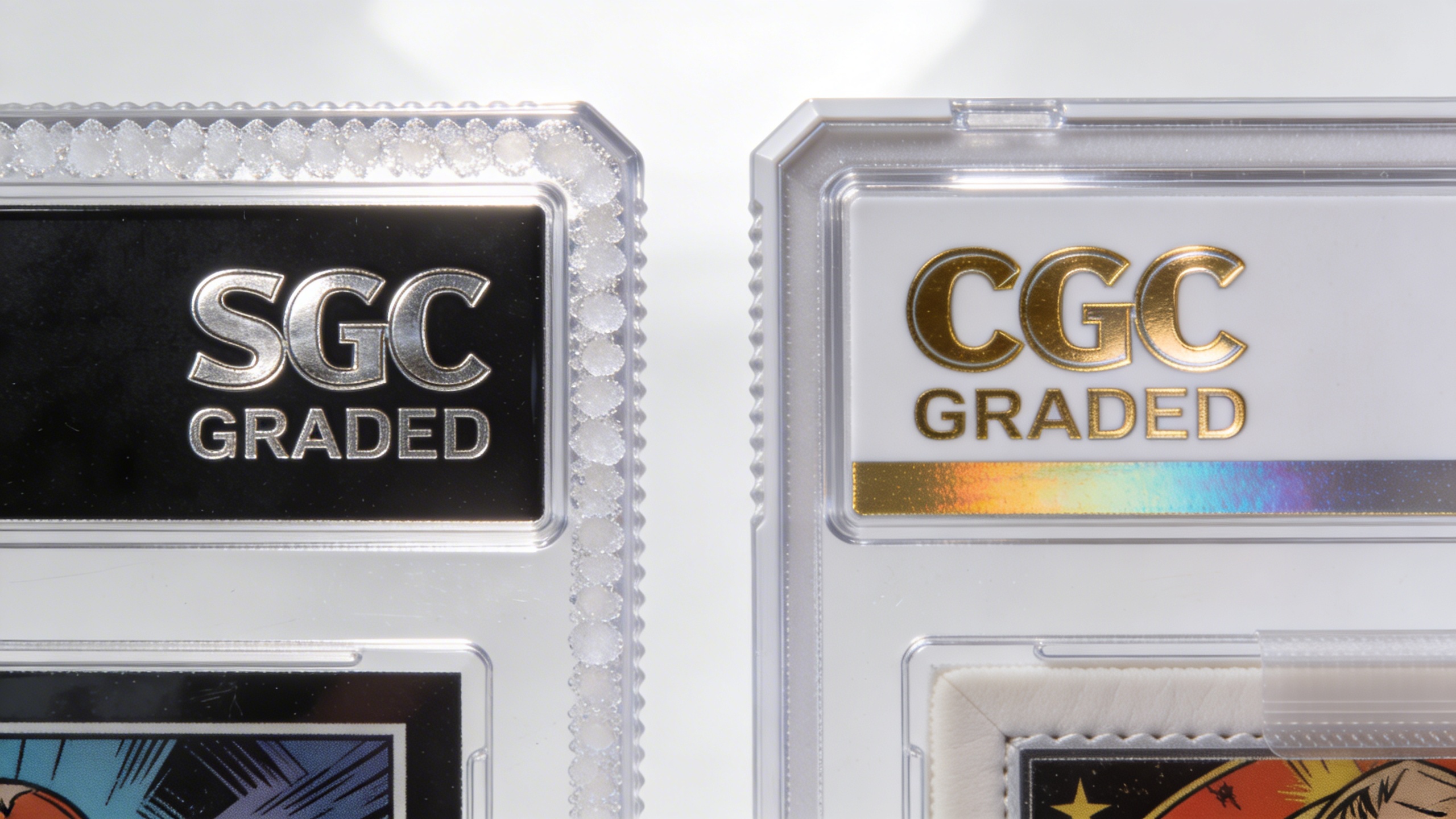
SGC holders feature a robust black-bordered design with clear polycarbonate construction that provides excellent impact resistance. The company’s signature tuxedo-style black border creates a premium appearance that many vintage card collectors prefer. SGC grading utilizes sonic welding technology to seal the holder edges, creating an airtight environment that prevents humidity and contaminant infiltration.
The holder dimensions measure approximately 4.5 x 3.5 inches with rounded corners that reduce stress concentration points. SGC’s construction method includes UV-resistant materials that help prevent yellowing over time, particularly important for long-term storage. The company also incorporates anti-static properties into their holders, reducing dust attraction during display.
CGC Holder Features and Protection
CGC grading cards utilizes a crystal-clear holder design with minimal visual obstruction, allowing maximum card visibility from all angles. The holders feature a two-piece construction with precision-fitted edges that create a secure seal without requiring adhesives or sonic welding. This approach allows for potential future re-evaluation if CGC’s policies permit.
The protection level includes scratch-resistant surfaces and reinforced corners that withstand typical handling and shipping stresses. CGC’s holders measure slightly larger at 4.75 x 3.75 inches, providing additional buffer space around the card. The company uses archival-quality materials that meet museum preservation standards, ensuring chemical stability for decades.
Label Information and Aesthetic Appeal
SGC labels display the grade prominently in large, bold numerals with the company logo and certification number clearly visible. The label includes card details such as year, manufacturer, player name, and card number. SGC grading costs are reflected in their premium label design, which features gold foil elements for higher grades and includes detailed authenticity verification codes.
CGC labels provide comprehensive information including the exact grade, certification number, and detailed card identification. The label design emphasizes clarity and readability with a clean, modern aesthetic. CGC grading cost includes their distinctive color-coded label system, where different grades receive different background colors for quick visual identification.
Both companies implement advanced security features including holographic elements, unique certification numbers, and tamper-evident seals. For collectors managing extensive inventories, apps like TCG Radar can help track graded cards by scanning certification numbers and maintaining digital records of holder conditions and grades.
Display preferences often depend on collection focus, with SGC’s black borders complementing vintage cards and CGC’s clear design highlighting modern cards’ vibrant colors and foil elements.
Market Value and Resale Impact
The choice between SGC and CGC grading significantly influences your cards’ market value and resale potential. Understanding how each grader performs in secondary markets helps collectors make informed decisions that maximize their investment returns.
SGC vs CGC Premium in Secondary Markets
Market data reveals distinct premiums for each grading service across different card categories. Vintage baseball cards in SGC holders consistently command 15-25% higher prices than identical CGC examples, particularly for pre-1980 issues. A 1952 Topps Mickey Mantle PSA 8 equivalent in SGC 88 recently sold for $485,000, while a comparable CGC 8.5 achieved $410,000 at auction.
Modern cards tell a different story. Pokemon and sports cards from 2000 onward often see CGC grading cards achieving premium valuations. CGC 10 examples of 2018 Panini Prizm Luka Doncic rookies average $2,850, compared to SGC 10 versions at $2,400. This 19% difference reflects collector confidence in CGC’s stricter modern card standards.
Trading card game enthusiasts particularly favor CGC for tournament-legal cards. Magic: The Gathering Alpha Black Lotus cards in CGC holders maintain stronger market positions due to the company’s gaming industry reputation. When considering sgc grading costs versus potential returns, vintage collectors typically see better ROI, while modern card investors often benefit more from cgc grading cost investments.
Auction Results and Price Comparisons
Heritage Auctions data from 2024-2025 shows clear market preferences by era. Pre-1970 baseball cards in SGC holders averaged 18% higher hammer prices than CGC equivalents across 847 comparable lots. The gap narrows for 1970s-1990s cards, with SGC maintaining just a 7% average premium.
| Card Era | SGC Average Premium | CGC Strength Categories |
|---|---|---|
| Pre-1960 | +22% | None significant |
| 1960-1979 | +14% | High-grade examples |
| 1980-1999 | +5% | Basketball, football |
| 2000-Present | -8% | All categories |
Regional auction houses show varying preferences. East Coast buyers traditionally favor SGC grading for vintage material, while West Coast markets demonstrate stronger CGC acceptance. International buyers increasingly prefer CGC for modern issues, particularly in Asian markets where gaming cards dominate collecting trends.
For collectors tracking card values and market trends, TCG Radar provides real-time price data across both SGC and CGC graded cards, helping identify optimal selling windows and grading service selection.
Future Trends and Market Evolution
Market evolution suggests continued specialization between services. SGC’s vintage dominance appears secure, with institutional collectors and investment funds consistently choosing SGC for pre-1980 acquisitions. The company’s authentication expertise and holder durability support long-term value retention for classic cards.
CGC’s trajectory points toward modern market leadership. Partnerships with gaming companies and digital collectible platforms position CGC favorably for emerging markets. Pokemon card values in CGC holders have increased 340% since 2022, compared to 180% for SGC examples.
Demographic shifts favor CGC’s growth prospects. Collectors under 35 show 68% preference for CGC grading cards, particularly in gaming categories. However, traditional sports card collectors maintain loyalty to SGC, creating parallel market ecosystems that may persist long-term.
Investment-grade cards benefit from strategic grading service selection. Vintage collectors should prioritize SGC for maximum resale value, while modern card investors typically achieve better returns through CGC. Understanding these market dynamics ensures optimal grading decisions that enhance portfolio performance over time.
Frequently Asked Questions
Which is better for Pokemon cards: SGC or CGC?
CGC is generally considered better for Pokemon cards due to their stronger presence in the TCG market and wider collector acceptance. CGC offers specialized TCG grading services with detailed subgrades and has built a solid reputation among Pokemon collectors. Their holders are also designed specifically for trading cards, providing better protection and presentation for Pokemon cards compared to SGC's sports-focused approach.
How much does SGC grading cost compared to CGC?
As of 2026, SGC typically offers more competitive pricing for standard submissions, with basic grading services starting around $15-20 per card. CGC's pricing is generally higher at $20-30 per card for standard service, but they offer more comprehensive grading options including subgrades. Both companies provide bulk discounts and express services at premium rates, making SGC more budget-friendly for large submissions.
Does SGC or CGC grade more strictly?
SGC is generally considered to have stricter grading standards, particularly for vintage cards, resulting in lower population counts for high grades. CGC tends to be slightly more lenient with modern cards but maintains consistent standards across their grading scale. Population reports show SGC awards fewer perfect 10 grades compared to CGC, making SGC 10s potentially more valuable in the long term.
Can CGC grade sports cards as well as comics?
Yes, CGC expanded into sports card grading and now offers comprehensive grading services for both vintage and modern sports cards. While they started with comics and TCGs, CGC has developed expertise in sports cards and competes directly with SGC in this market. However, SGC still maintains a stronger reputation and longer track record specifically in the sports card grading industry.
Which grading company has faster turnaround times?
SGC typically offers faster turnaround times, with standard submissions processed in 10-15 business days compared to CGC's 15-25 business days. SGC's streamlined operations and focus on cards allows for quicker processing, while CGC handles multiple collectible categories which can slow their workflow. Both companies offer express services for faster turnaround at premium pricing, with SGC's express options generally being 2-3 days quicker than CGC's.