PSA Card Grading in 2026: Fees, the Value Tier Pause, Turnaround and the Grading Scale
PSA (Professional Sports Authenticator) grades more cards than every other company combined, and since 2 June 2026 it has refused new orders at every price under $80. The four Value tiers, from $24.99 to $64.99, are paused while PSA works through a backlog it reported at 12.4 million cards on 28 July 2026. The cheapest PSA service you can order today is Regular at $79.99 per card, with a published turnaround of 40–50 business days.
Everything below was checked against PSA’s price list and backlog tracker on 3 September 2026. The page is organised around the questions people actually type: what it costs, when the cheap tiers come back, how long it takes, how the grade is decided, and whether a $79.99 slab is worth it for the card in your hand.
PSA grading fees in 2026
PSA prices by service level, and each level has a maximum declared value per card. Declare honestly: PSA checks the value at intake and moves the card to the correct tier at your expense if it is under-declared. All five open tiers include a 1–10 grade, a serial-numbered cert and entry in the population report.
| Service level | Fee per card | Max declared value | Published turnaround | Status (3 Sep 2026) |
|---|---|---|---|---|
| Value Bulk (20-card minimum) | $24.99 | $500 | 95 business days | Paused since 2 Jun 2026 |
| Value | $32.99 | $500 | 75 business days | Paused since 2 Jun 2026 |
| Value Plus | $49.99 | $500 | 45 business days | Paused since 2 Jun 2026 |
| Value Max | $64.99 | $1,000 | 30 business days | Paused since 2 Jun 2026 |
| Regular | $79.99 | $1,500 | 40–50 business days | Open |
| Express | $149 | $2,500 | 20–30 business days | Open |
| Super Express | $349 | $5,000 | 10–15 business days | Open |
| Walk-Through | $599 | $10,000 | 7–10 business days | Open |
| Premium 1 | $999 | $25,000 | 5–7 business days | Open |
Above Premium 1 there are further Premium levels for cards declared at $50,000 and up, priced as a percentage of value. The Value tiers required a paid Collectors Club membership; the open tiers do not, and PSA extended existing memberships to compensate members who lost access to the tiers they had paid for. Shipping is extra in both directions and is charged on the order for the return leg. The card grading cost calculator adds shipping and hides paused tiers so the total reflects what can be ordered.
When will PSA’s Value tiers reopen?
PSA has not given a date. What it has given is a number: the pause lifts when the active backlog is down to about 5 million cards. The announcement on 28 May 2026 put the backlog near 10 million and estimated four months to get there; the July update showed the backlog had risen to 12.4 million after a rush of submissions ahead of the cutoff, and PSA revised the estimate to five to six months from June, which points at November or December 2026 at the earliest. PSA publishes the figure monthly on its public backlog tracker, so the honest answer to “when” is “watch the tracker, and expect the first reopening to be partial”.
Three ways to keep grading in the meantime:
- Pay for Regular if the card is worth more than about $400. At that value the $79.99 fee is under a fifth of the card and a PSA 10 outcome usually multiplies it.
- Use a grader with open tiers. SGC’s Standard is $15 with a $1,500 cap and a 40–50 day estimate; CGC Cards’ Economy is $20 with a $1,000 cap at 90 days, and its Bulk is $17 for 25 or more cards. Both companies had every tier open on the check date. The grading alternatives finder filters by budget and turnaround.
- Grade at a show. PSA takes on-site submissions at major events at Express pricing and above; it saves shipping and the intake delay but not the fee.
How long does PSA grading take?
The published estimates are business days from the moment PSA logs the package as received, not from shipment. Regular at 40–50 business days is eight to ten calendar weeks, plus a week or two for transit and intake, so budget three months from mailbox to mailbox. Express at 20–30 days is roughly six weeks all in. The Value tiers were quoting 75–95 days before they closed, and PSA has said the reopened tiers will carry similar or longer estimates until the backlog is cleared.
Order status in your PSA account moves through Arrived, Research and ID, Grading, Assembly, Quality Assurance and Shipped. Most of the elapsed time is spent waiting to enter Grading; once a card reaches Assembly it is usually out the door within days. The grading turnaround planner converts a tier’s business-day estimate into a calendar date and warns when a submission cannot make a deadline you set.
The PSA grading scale, centering standards and qualifiers
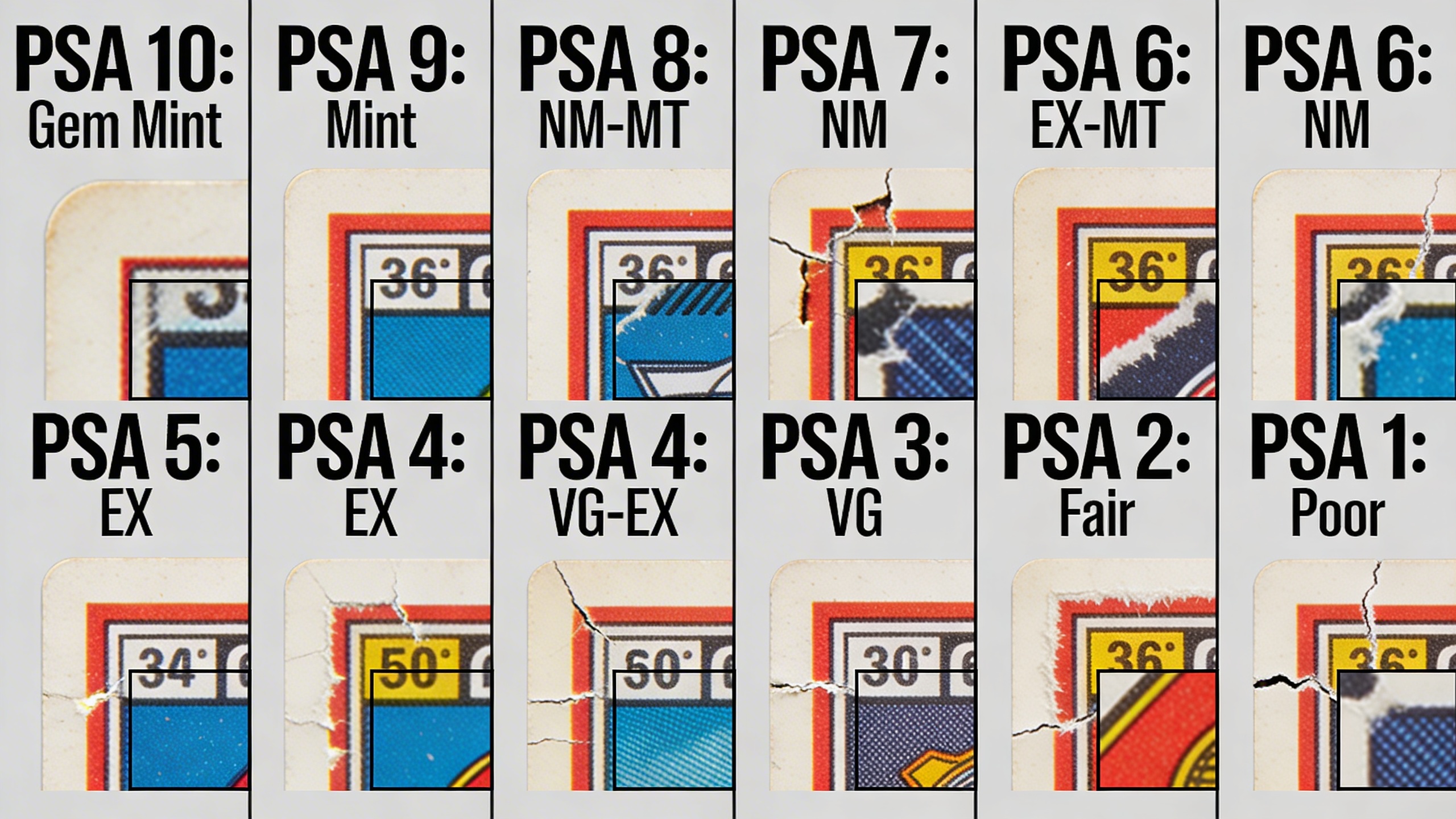
PSA grades 1 to 10 with half grades from 1.5 to 8.5. There is no 9.5: a card is a 9 or a 10. Unlike Beckett, PSA prints one number with no subgrades, so the label tells a buyer less but the number itself is what most price guides and auction comps are keyed to.
| Grade | Name | Front centering | Back centering | What is allowed |
|---|---|---|---|---|
| 10 | Gem Mint | 55/45 to 60/40 | 75/25 | Four sharp corners, full gloss, no print lines or staining; a barely visible flaw at most |
| 9 | Mint | 60/40 to 65/35 | 90/10 | One minor flaw: a slight print spot, a touch of wax stain, faint corner wear |
| 8 | Near Mint–Mint | 65/35 to 70/30 | 90/10 | Slight wear on two corners or a small print defect |
| 7 | Near Mint | 70/30 to 75/25 | 90/10 | Slight surface wear, minor corner fraying |
| 6 | Excellent–Mint | 80/20 | 90/10 | Visible corner wear, light scratching, minor loss of gloss |
| 5 | Excellent | 85/15 | 90/10 | Rounded corners, noticeable surface wear, no creases |
| 4 and below | VG-EX to Poor | 90/10 and worse | Creases, chipping, paper loss, writing |
A qualifier is a two-letter suffix PSA adds when a card meets the grade on every count but one: OC (off-center), MC (miscut), ST (staining), PD (print defect), OF (out of focus), MK (marks). A PSA 8 (OC) is a card that would be an 8 if centered and is priced roughly like a 6. When you submit you can tick “no qualifiers”, in which case PSA lowers the grade instead of adding the suffix, and for anything you intend to sell that is the better choice: a clean lower number sells more easily than a higher number with a suffix.
Centering is measured before anything else, and it is the criterion collectors most often get wrong by eye. Measure the borders with a ruler or the card centering calculator; if the front is worse than 60/40, the ceiling is a 9 whatever the corners look like. The card grade estimator walks through the other criteria in the order PSA applies them.
PSA vs BGS, CGC and SGC: what changes in 2026
For years the argument for PSA was liquidity: a PSA 10 is the grade buyers search for, and it sells for more than the same card in any other holder. That is still true, and the pause has not changed it. What has changed is the entry price. Before June, PSA was the mid-priced option; today it is tied with Beckett’s Express at about $80, while SGC and CGC still take cards at $15 to $20.
| Grader | Cheapest open tier (3 Sep 2026) | Turnaround | Resale position |
|---|---|---|---|
| PSA | Regular, $79.99, cap $1,500 | 40–50 days | Highest price for a 10 on most cards; reference pop report |
| Beckett (BGS) | Express, $79.95, cap $2,500 | 15 days | Subgrades; Black Label 10 beats a PSA 10, a 9.5 trails it |
| CGC Cards | Economy, $20, cap $1,000 | 90 days | Strong on TCG; Pristine 10 label; discounts below PSA |
| SGC | Standard, $15, cap $1,500 | 40–50 days | Vintage sports accepted at near-PSA prices; modern at a discount |
The practical rule while the Value tiers are closed: send PSA the cards that will be worth $400 or more graded, send SGC the vintage cards you want slabbed cheaply, and send CGC the modern TCG cards you are grading for your own collection. Full detail is in the Beckett grading guide, the SGC vs CGC comparison and the five-company grading comparison. The grading scale converter translates a grade from one company to the others.
How to submit cards to PSA
- Create a PSA account at psacard.com. Collectors Club membership is not required for Regular and above.
- Start a submission and add each card by searching PSA’s card database, which fills in year, set and number. Enter a declared value per card; it sets the tier and the insurance.
- Pick the service level. All cards in one submission must be on the same tier; split high-value cards into their own order so they do not drag the whole batch up a tier.
- Choose your options: no qualifiers, minimum grade (PSA returns the card ungraded if it would grade below your minimum, for a reduced fee), and whether you want the card back in a semi-rigid rather than a slab if it fails authentication.
- Prepare the cards: penny sleeve, then a Card Saver 1 semi-rigid. PSA states that top-loaders and screw-downs are not accepted.
- Pack and ship in the order listed on the printed form, between cardboard, in a box the cards cannot shift in. Insure for the declared total.
- Pay on completion: PSA charges the card on file when grading is finished, including the return shipping, and posts the grades to your account a day or two before the package ships.
Is PSA grading worth it at $79.99?
The break-even is simple: the slabbed price minus the raw price has to beat the fee plus shipping plus the value you lose if the grade disappoints. At $79.99 plus about $5 per card of shipping on a ten-card order, three cases:
| Card | Raw | Likely outcome | Cost | Net |
|---|---|---|---|---|
| Modern base-set holo, mass produced | $20 | PSA 10 at $65, PSA 9 at $25 | $85 | Loses money at either grade |
| Vintage star, sharp, well centered | $250 | PSA 8 at $600 | $85 | +$265 |
| Modern chase card, 60% chance of a 10 | $300 | PSA 10 at $1,100, PSA 9 at $380 | $85 | Expected +$527; −$5 if it grades 9 |
The first row is what the Value pause was designed to stop: cheap cards that only made sense to grade at $25. The third row is where PSA still earns its fee, and it is also where pre-grading matters most, because the difference between the two outcomes is the entire profit. Put your own probabilities into the grading ROI calculator before you ship, and use the grading submission planner to rank a pile of candidates by expected return.
Other PSA services worth knowing
- PSA/DNA authenticates autographs; the Dual service grades the card and the signature in one holder, and it is how most modern autographed rookies are slabbed.
- Cert verification at psacard.com lets any buyer type the cert number on a label and see the card, grade and, on newer slabs, a photo. Check it before buying any PSA slab from a private seller.
- Population report shows how many copies PSA has graded at each grade. A PSA 10 with a pop of 4 and a PSA 10 with a pop of 4,000 are different assets, and the report is free.
- Reholder puts a cracked or scuffed slab into a fresh holder at the same grade; Review asks PSA to reconsider a grade you think is low; Crossover takes a card slabbed elsewhere and regrades it, with a minimum grade you set.
- Grades on the label are also reported as a whole-card “PSA 10” in the cert database, which is what price-tracking apps read; a card scanner that reads the cert barcode saves retyping.
Sources and check date
Fees, value caps and turnaround estimates were read from PSA’s trading card grading services page on 3 September 2026. The pause date, backlog figures and reopening target are from PSA’s service-level update of 28 May 2026 and its public backlog tracker, last read on the same date. Centering standards are PSA’s published grading standards. Competitor fees come from each company’s own price list on the same date. Verify on psacard.com before submitting; the backlog figure changes monthly.