Beckett Grading in 2026: Fees, Paused Tiers, Turnaround and How the BGS Grade Is Built
Beckett Grading Services (BGS) is the second-largest card grader in the hobby and the only major one that prints four subgrades on the label. Its two cheapest tiers, Base ($14.95) and Standard ($34.95), have been closed to new online submissions since 8 August 2026, and the company says it expects to begin reopening them on 15 September 2026. Until then the cheapest Beckett slab you can order online is Express at $79.95 per card, which is almost exactly what PSA charges for its cheapest open tier.
This page is kept as a working reference rather than an essay: every fee, cap and turnaround below was read from Beckett’s own price list on 3 September 2026, and the pause status from Beckett’s service notice last updated 5 August 2026. If you are deciding whether to send cards to Beckett this month, the first two sections answer that. The rest explains how the grade is built, how it compares with PSA, CGC and SGC, and how to submit.
How much does Beckett grading cost in 2026?
Beckett prices per card by service level. Each level carries a maximum declared value: if your card is worth more than the cap, you have to move up a tier. Subgrades are included from Standard upward; on Base they cost an extra $3, and a card that earns a perfect 10 in any subgrade triggers a further $3 upcharge on that tier.
| Service level | Fee per card | Max declared value | Published turnaround | Status (3 Sep 2026) |
|---|---|---|---|---|
| Base, no subgrades | $14.95 | $250 | 75–90 business days | Paused since 8 Aug 2026 |
| Base with subgrades | $17.95 | $250 | 75–90 business days | Paused since 8 Aug 2026 |
| Standard | $34.95 | $1,000 | 45 business days | Paused since 8 Aug 2026 |
| Express | $79.95 | $2,500 | 15 business days | Open |
| Priority | $124.95 | $5,000 | 5 business days | Open |
Two things the fee table does not show. First, shipping: a small insured submission of up to ten cards typically costs $12 to send and $18 to get back, so a single Express card really costs about $110 door to door. Second, there is no membership requirement. PSA’s paused Value tiers needed a Collectors Club account; Beckett never has. Run your own numbers, including shipping and the value cap, in the card grading cost calculator, which hides paused tiers by default so you only see what can actually be ordered.
Which Beckett services are paused, and when do they reopen?
On 5 August 2026 Beckett announced it would stop accepting online Base and Standard submissions from 8 August. The stated reason is volume: the company said card submissions were up 102% year over year, and trading card game submissions specifically were up 159%. Express and Priority never closed, cards already in transit are being received normally, and everything already logged keeps moving through the queue.
The reopening date Beckett has given is 15 September 2026, phrased as “expects to begin reopening”, which leaves room for a staggered return. There are two workarounds while the pause lasts:
- Event drop-off. Beckett has allowed limited Base and Standard intake at shows during the pause, most recently listing the Dallas Card Show on 10–13 September 2026. Capacity is capped and closes once the allotment is filled, so it is a queue, not a guarantee.
- Pay for Express. At $79.95 with a 15-business-day turnaround, Express is roughly five times the Base price but a fifth of the wait. For a card worth more than about $400 the fee is a small share of value; for bulk modern it is not.
The same squeeze is happening across the industry. PSA paused all four of its Value tiers on 2 June 2026 against a backlog it reported at 12.4 million cards on 28 July, and TAG has its Basic and Standard tiers closed. As of the September check, only CGC Cards and SGC have every tier open. If your plan was “cheap slab, long wait”, the grading alternatives finder shows what is orderable today at your budget.
How long does Beckett grading take?
Published business-day estimates are 15 for Express and 5 for Priority, and those two tiers have broadly held their estimates through the pause because the pause exists to protect them. Base and Standard were quoting 75–90 and 45 business days before they closed, and it is reasonable to expect the first reopened batches to run at the long end of those ranges.
The clock starts when Beckett logs your package, not when the courier delivers it; at busy periods the gap between the two has run to a week or more. Add the outbound and return shipping, and a 15-business-day Express order is a calendar month in practice. The grading turnaround planner converts business days into a delivery date and lets you set a deadline, which matters if you are grading ahead of a sale or a show.
The Beckett grading scale and how the final grade is built
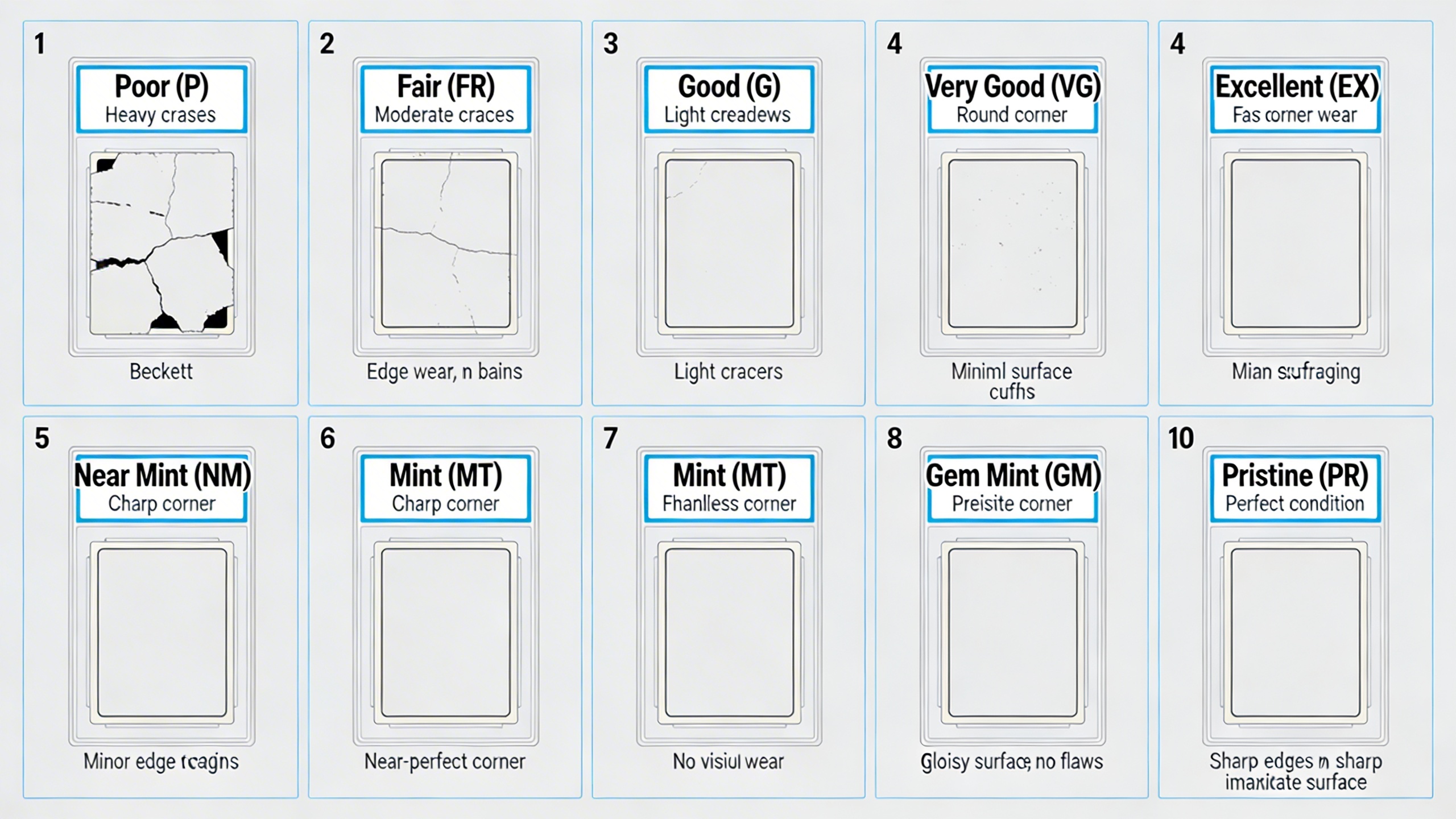
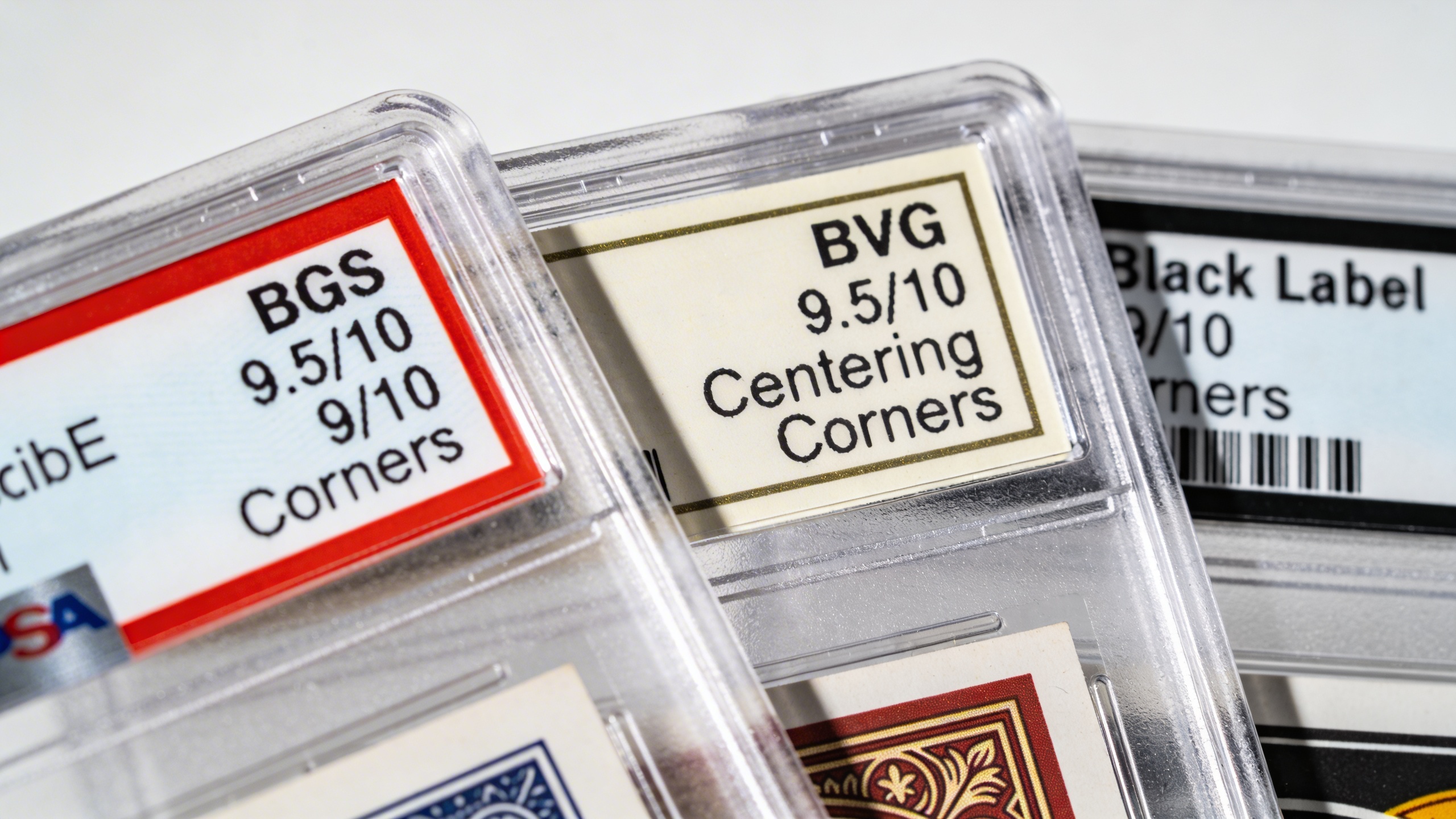
Beckett grades on a 1 to 10 scale in half-point steps, the same range PSA uses. The difference is that a BGS label shows four subgrades, each on the same 1–10 scale:
- Centering: how evenly the borders are distributed, front and back.
- Corners: sharpness and wear at all four corners.
- Edges: chipping, roughness and print flaws along the borders.
- Surface: scratches, print lines, dents, staining and gloss.
The overall grade is not an average. Beckett anchors it to the weakest subgrade and only lets the other three pull it up by a limited amount. The thresholds that matter to resale are:
| Overall grade | Label | Subgrade requirement |
|---|---|---|
| 10 Pristine (Black Label) | Black | All four subgrades 10 |
| 10 Pristine | Gold | At least three 10s, the fourth no lower than 9.5 |
| 9.5 Gem Mint | Gold | At least two subgrades of 9.5 or higher, none below 9 |
| 9 Mint and below | Silver | No fixed subgrade pattern; the overall is anchored to the lowest subgrade and lifted at most half a point by the other three |
Two practical consequences. A card with three 10 subgrades and a 9 centering score is a 9.5, not a 10, so centering is the subgrade to check with a ruler before you pay for Express; the card centering calculator turns border measurements into a predicted centering subgrade. And because the subgrades are printed, a BGS 9.5 with a 10 in centering and corners sells for more than a BGS 9.5 with four 9.5s, even though the headline grade is identical. That granularity is the whole reason modern-card collectors choose Beckett.
Beckett vs PSA vs CGC vs SGC in 2026
The honest comparison in September 2026 is between what each company will actually accept, not the price list each company publishes. Cheapest orderable tier per company, from the 3 September check:
| Grader | Cheapest open tier | Fee | Value cap | Turnaround | Cheapest tier overall |
|---|---|---|---|---|---|
| Beckett (BGS) | Express | $79.95 | $2,500 | 15 days | Base $14.95, paused to 15 Sep |
| PSA | Regular | $79.99 | $1,500 | 40–50 days | Value Bulk $24.99, paused since 2 Jun |
| CGC Cards | Bulk (25+ cards) | $17 | $500 | 150 days | Open |
| SGC | Standard | $15 | $1,500 | 40–50 days | Open |
| TAG | Express | $59 | $1,000 | 10–15 days | Basic $22, paused |
On resale, the pattern that has held for years still holds: for most cards a PSA 10 brings the highest price, a BGS 9.5 sells below a PSA 10, and a BGS 10 Black Label sells above a PSA 10, often by a wide multiple because so few exist. Where Beckett wins outright is thick modern cards with patches and autographs, where buyers want the subgrades, and where the card’s value depends on centering. Where PSA wins is vintage and anything bought by comp: PSA’s population report is the reference most price guides key on.
The same-card-different-grader question comes up constantly, so we keep a grading scale converter that maps a BGS grade and its subgrades to the PSA, CGC and SGC equivalents, and a grading companies directory with each company’s live tier status. Our separate write-up on BGS grading for Pokémon cards covers the TCG-specific side, and the PSA grading guide is the mirror of this page for PSA.
How to submit cards to Beckett
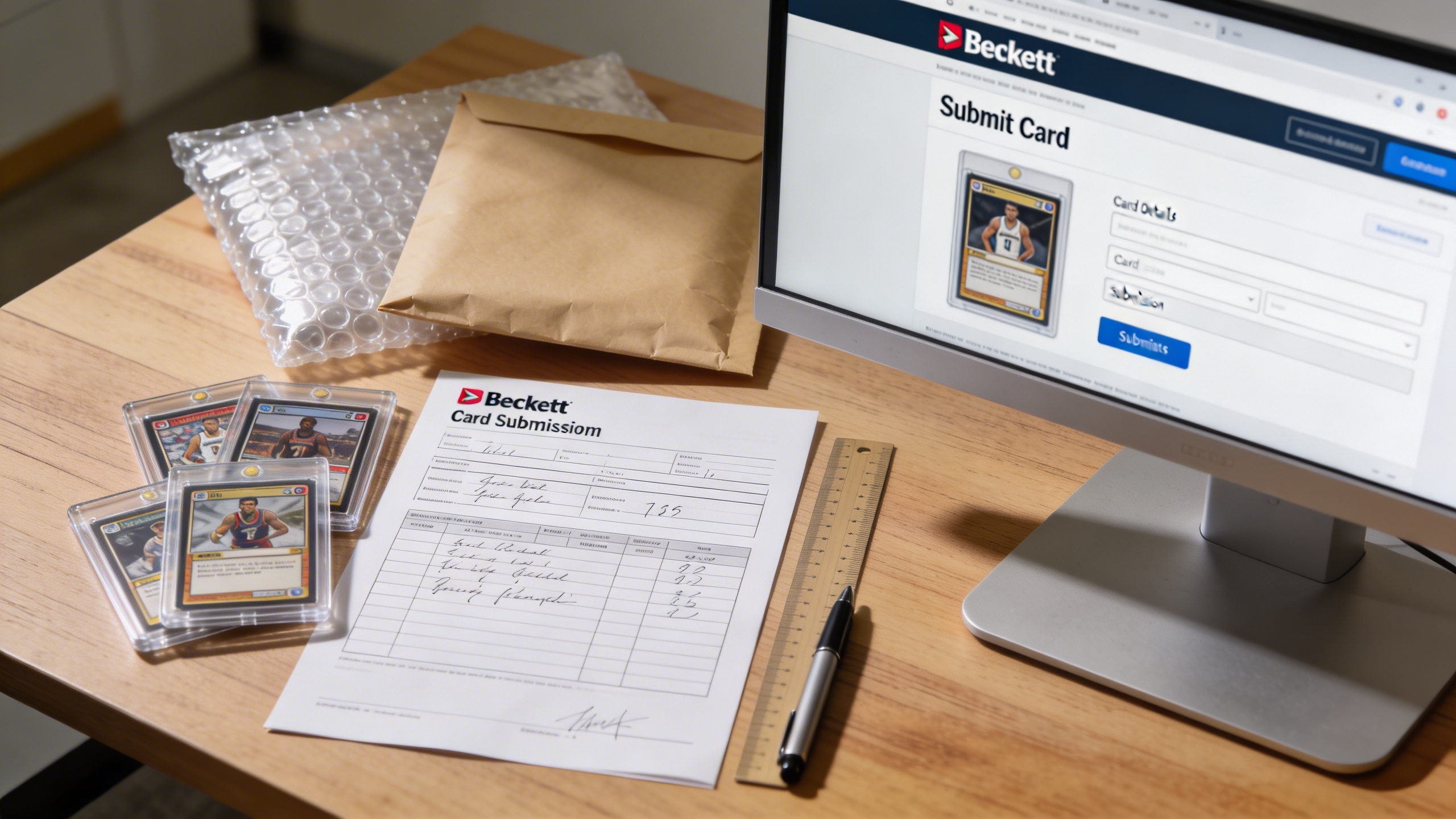
- Create a free account at beckett.com and open the grading submission form. There is no paid membership tier.
- Add each card with year, set, number and a declared value. The declared value decides the minimum tier and what the card is insured for in transit and in Beckett’s building. Under-declaring to get a cheaper tier is the most common mistake and it is caught at intake, where the card is bumped to the correct tier and you are billed the difference.
- Choose the service level and, on Base when it reopens, decide whether to pay for subgrades. For anything you plan to sell, pay for them: a BGS slab without subgrades sells at a discount to one with them.
- Sleeve and semi-rigid every card: penny sleeve first, then a Card Saver 1 or equivalent semi-rigid holder. Do not use screw-down or top-loaders, which get rejected or damage the card in transit.
- Pack in order between two pieces of cardboard, with the printed submission form on top, in a box that does not let the stack move. Ship insured with tracking; the return shipping fee is charged on the order.
- Track the order in your account. Statuses move from Received to Grading to Shipped; the turnaround clock starts at Received.
If you are deciding which cards from a larger pile deserve a slot, the grading submission planner ranks them by expected return at the tiers that are open, and the card grade estimator is a pre-grading checklist that flags the defects that cap a Beckett subgrade.
Is Beckett grading worth it? The arithmetic
Grading pays when the graded price minus the raw price exceeds the fee, shipping and the probability-weighted risk of a low grade. With Base paused, the entry fee is $79.95, which moves the break-even sharply. Three worked cases at Express pricing, with $30 round-trip shipping spread over ten cards ($3 per card):
| Card | Raw value | Likely grade and price | All-in cost | Net gain |
|---|---|---|---|---|
| Modern base rookie | $25 | BGS 9.5 at $60 | $83 | −$48: do not grade at Express |
| Numbered rookie autograph | $400 | BGS 9.5 at $900 | $83 | +$417 |
| Same card, if it grades 9 | $400 | BGS 9 at $450 | $83 | −$33 |
The middle row is the whole case for Beckett: cards where the subgrades justify a premium and where the raw value already exceeds about five times the fee. The third row is the risk you are pricing in, which is why estimating the grade before you pay matters more than choosing the company. The grading ROI calculator runs this with your own grade probabilities.
Beckett services beyond BGS
- Beckett Vintage Grading (BVG) handles pre-1981 cards in a holder designed for older, thinner stock, with the same subgrade system. In the market, BVG slabs trade at a discount to PSA for the same vintage card, so most vintage sellers still send to PSA or SGC.
- Beckett Authentication Services (BAS) authenticates autographs, on cards and on memorabilia, and issues the “Auto 10” grade seen on high-end rookie patch autographs. The Mahomes 2017 National Treasures 1/1 that sold for $4.3 million in July 2021 carried a BGS 8.5 with a BAS Auto 10.
- Raw Card Review (RCR) is an on-site pre-grade offered at shows: a Beckett grader looks at the raw card and tells you what it would grade, so you can decide whether to pay for a slab. It is the closest thing to a refund on a bad grade the hobby offers.
- Crossovers let you send a card already slabbed by another company and ask Beckett to regrade it, usually with a minimum grade you will accept; if Beckett cannot meet it, the card is returned in the original holder.
- Population report at beckett.com lists how many copies of each card Beckett has graded at each grade, which is what turns a Black Label from “perfect” into “one of three”.
Sources and check date
Fees, value caps and turnaround estimates were read from Beckett’s grading price list on 3 September 2026. Pause and reopening details are from Beckett’s “Base & Standard Submission Availability” notice, last updated 5 August 2026, and Beckett’s statements to trade press on submission growth. Competitor fees are from each company’s published price list on the same date. Prices move; treat anything older than a quarter as a starting point and confirm on the grader’s site before you ship.